New Games - Page 12403

King's Knight
1986
King's Knight
1986
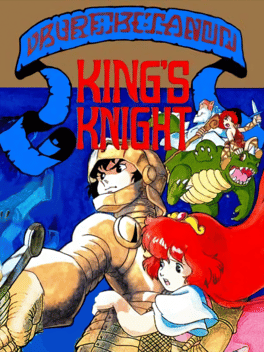
star 5.1King's Knight is a fantasy-themed top-down shooter where four heroes have to unite to defeat a dragon and rescue a princess in despair. It was one of the first games published by Square Soft (now one-half of Square Enix). King's Knight is a variation on Konami's Knightmare which sold extremely well. The first four stages involve you powering up your characters as far as they can go, picking up shields (to increase defense), boots (to increase speed), swords (to increase attack power), and spell icons (which will be required to be held by everyone for the final storm on the castle), defeating monsters along the way. The power-ups are hidden underneath mountains, rocks, and houses. Nearly everything can be shot at and destroyed. The heroes are, in order: Ray Jack, the Knight, who possesses strong attacking power; Kaliva, the Wizard, who is good with magic and jumping; Barusa, the Monster, who has a strong defense; and Toby, the Thief, who can move swiftly. It is necessary to keep all four heroes alive for the fiftMoonmist
1986
Moonmist
1986
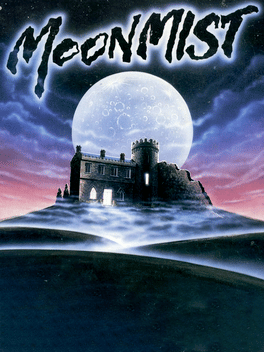
star 6.9Moonmist is an interactive fiction computer game written by Stu Galley and Jim Lawrence and published by Infocom in 1986. The game was released simultaneously for many platforms, including the IBM PC, Apple II, Amiga, Atari ST and Commodore 64. It is Infocom's twenty-second game. Galley and Lawrence previously wrote Seastalker for Infocom. The player's character is a young detective, asked by friend Tamara Lynd to investigate her new home of Tresyllian Castle in Cornwall, England. Tamara has recently become engaged to the castle's lord, Jack Tresyllian. She was very happy until she began seeing what appeared to be The White Lady, a ghost who has allegedly haunted the castle for centuries. As if seeing a ghost wasn't nerve-racking enough, she's also begun to fear for her life. Is Tamara's imagination just overly excited from living in a large old castle, or is someone really trying to kill her? And if her life is in danger, is it from a ghost or someone using it as a disguise?KiKi KaiKai
1986
KiKi KaiKai
1986
star 6.2A shooter where you fight ghosts and zombies and other creatures of the afterlife.Takahashi Meijin no Bouken-jima
1986
In the South Pacific, Master Higgins lives peacefully wearing only a grass skirt and a cap. That is until the Evil Witch Doctor decides to capture the Princess Leilani and hold her as his own. It's up to Master Higgins to gather throwing axes, fireballs and skateboards in order to aid his noble quest. The game is a side scroller, Master Higgins moves across the screen from left to right and finds his power-ups in giant eggs. This includes a skateboard which results in a great speed enhancement - until Master Higgins gets hit and loses his power. If he is not on a skateboard a hit means instant death. Another game mechanic is starvation which gets indicated through a meter which steadily decreases. If it hits zero the hero dies and the only way to fill it up is by collecting food on the way. Bosses await him at the end of levels, all the way to the Evil Witch Doctor himself.Hudson's Adventure Island
1986
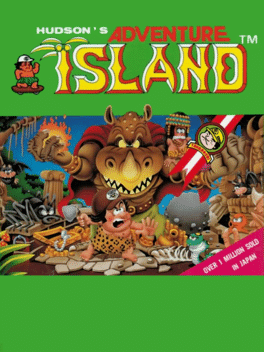
star 7.1Hudson's Adventure Island, also known simply as Adventure Island and released in Japan as Takahashi Meijin no Bouken-jima, is a side-scrolling platform game produced by Hudson Soft that was first released in Japan for the Famicom and MSX on September 12, 1986. It was later released in North America for the Nintendo Entertainment System on September 1988 and in the PAL region in 1992 under the title of Adventure Island Classic. Adventure Island is an adaptation of the arcade game Wonder Boy, originally published by Sega for developer Escape (now known as Westone Bit Entertainment). Adventure Island was followed by a series of sequels that were independently developed by Hudson Soft.Banana
1986
Banana
1986
The game takes place in a world called Banana Land, which is populated by anthropomorphic moles. Mr. Mole is on a picnic with his wife and son when an earthquake strikes, trapping his wife and son underground! Help Mr. Mole rescue his wife (and sometimes son) and find their way to the exit through underground areas of varying design. The game features 105 stages and a custom stage design mode. The object of each stage is to make it to the exit after picking up all the various food items and Mr. Mole's family members. There is no way to "die" as such, but the player can make a mistake and make a stage impossible to complete; for this reason the player can "give up" by pressing the A and B buttons simultaneously to re-try the stage.Musashi no Ken: Tadaima Shugyou-chuu
1986
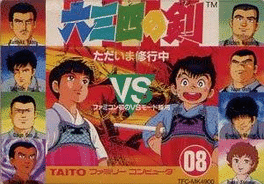
Musashi no Ken: Tadaima Shugyou-chuu is a 1986 video game software developed and published by Taito exclusively in Japan. It is based on a Japanese sports manga series written and illustrated by Motoka Murakami that focuses on kendo, simply titled Musashi no Ken. The gameplay and design in the one-on-one fighting parts resemble Taito's other fighting game, Great Swordsman, especially its kendo mode. The game's plot is about the son of two Kendo champions named Musashi. He strives to become as great at Kendo as his parents. The entire story centers around the world of Kendo and its up and coming competitors. The anime is broken up in to two parts. The first part follows Musashi's early years in grade school while the second part follows his high school years. In the first episode, Musashi befriends an Akita puppy who is by his side throughout the series.Super Pitfall
1986
Super Pitfall
1986
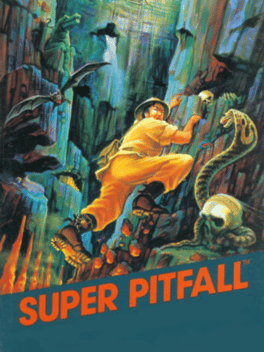
star 3.6Pitfall Harry returns to adventuring in this "Super" sequel to Pitfall! and Pitfall II: Lost Caverns. Harry’s mission: to recover the famed Raj Diamond, and also to rescue his niece Rhonda and loyal lion sidekick, Quickclaw. Now armed with a gun, Harry must navigate some 270 screens of 8-bit action-platforming. Valuable items will be collected along the way to aid your quest, but beware: dangers also abound, from snakes and spiders to falling rocks and boiling lava!Come on Picot
1986
Come on Picot
1986
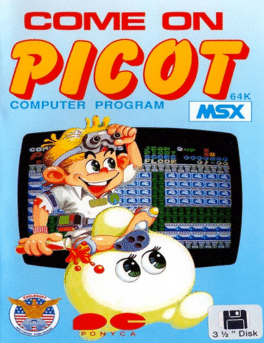
Jean has been separated from his girlfriend due to the world war going on, and now he must find her again, aided by the friendly blob Picot. The game is a flick-screen platform game where the protagonist is powerless, but can command Picot to help him. Picot is very versatile; you may walk behind her so that she destroys incoming enemies, you may ride on her and you may give her a push so that she bounces around the screen like a deadly ball. However, Picot is much slower than Jean, and cannot climb stairs. If Jean calls out for Picot, though, she will reach him even if it means clawing her way up against the backdrop. If Jean stands on top of Picot and call for her, she will climb higher and higher, so that out-of-reach places on the screen may be reached.Le Pacte
1986
Le Pacte
1986
e Pacte is an horror style adventure game published by the French Company Loriciels in 1986. The story revolves around the player being part of a team sent to investigate the house of Amityville, with two other parapsychologists called Evrett Wilson and Laura Relfod (plus their dog, Black). The game does not use a textual interface, like most of the adventure games of its time; instead the player has to associate two words within a very long list.Alpha Mission
1986
Alpha Mission
1986
Alpha Mission was developed by SNK and G1M2 for the Famicom and Nintendo Entertainment System after success as an Arcade installation. It is a vertical scrolling shooter that has similarities to Xevious, with the use of air-to-air and air-to-ground weapons.Firework Thrower Kantaro's 53 Stations of the Tokaido
1986
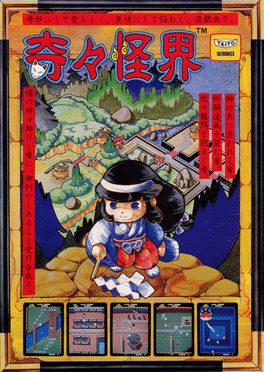
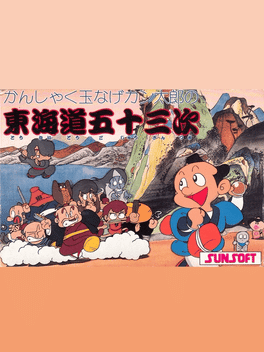
Although commonly referred to as Toukaidou Gojuusan-tsugi, the full name of the game is Kanshakudama Nage Kantarou no Toukaidou Gojuusan-tsugi, which can be roughly translated as "explosive throwing Kantarou and the 53 stations of the Toukaidou". To further explain the main character's name is Kantarou, and he throws bombs at his enemies. He is attempting to travel from Kyoto back to Edo (known today as Tokyo) to see his girlfriend Momoko. To get there, he is traveling through the Toukaidou highway which is composed of 53 checkpoints along the way. However, an unscrupulous merchant is attempting to capture Kantarou and steal his explosive technique secrets. Toukaidou Gojuusan-tsugi is a horizontally scrolling action game developed by Sunsoft in 1986. It was never released outside of Japan. On June 29, 2001, the game was released for the Windows platform as part of Sunsoft Classic Games 2 along with Ikki (which was itself rereleased as a budget title in 2004). On December 27, 2001, the game was released on the PlayChoplifter
1986
Choplifter
1986
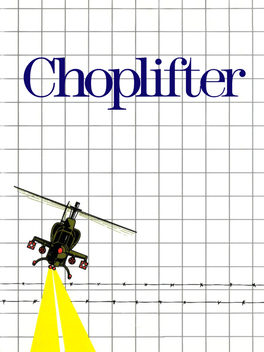
Choplifter is a Master System port based on Sega’s arcade conversion of the original Apple II game.Space Harrier
1986
Space Harrier
1986
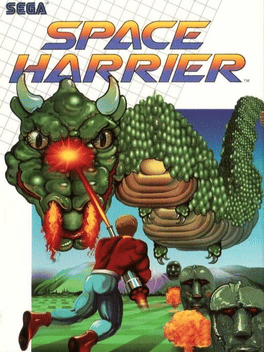
The North American Commodore 64 port of Space Harrier. Elite handled the home computer ports for Europe and North America, however each version is a unique port of the game. Differences in this version include different sprites and a multi-colored scrolling effect on the ground rather than the flat color that was in the European release.WEC Le Mans 24
1986
WEC Le Mans 24
1986
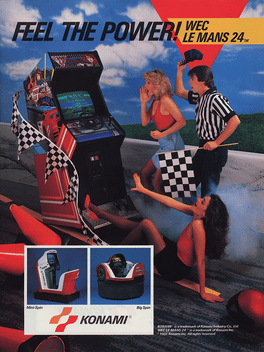
An early racing simulator based on the 24 Hours of Le Mans. It was a pioneer of realistic simulation racing, and featured a unique cabinet that rotated to simulate the feel of driving a car.Soldier of Light
1986
Soldier of Light
1986
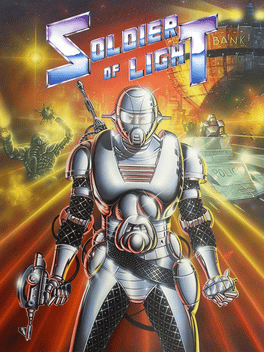
Soldier of Light is an arcade game released in 1986 that has both side-scrolling shooter and platforming elements.Snail Maze
1986
Snail Maze
1986
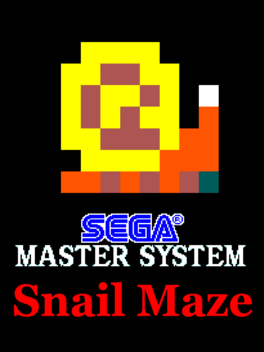
Snail Maze is a 1986 video game by Sega, part of the Sega Master System. Instead of being released on a cartridge, it was built into the system's BIOS and could be played by starting the system without a game cartridge inserted and holding Up and buttons 1 and 2 simultaneously. The later "Master System II" model did not include Snail Maze, it instead included a built in Alex Kidd in Miracle World. Snail Maze was never released in cartridge or card format.Ardok the Barbarian
1986
Ardok the Barbarian
1986
Asterix and the Magic Cauldron was changed to Ardok the Barbarianon the worldwide C64 release of the game because they lost their license. Most sources today only talk about the North American changeKing Kong 2: Yomigaeru Densetsu
1986
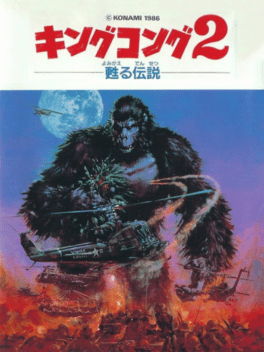
A giant ape King Kong, which was shot and fell off the World Trade Center tower, appears to be alive, but is in coma for 10 years and desperately needs a blood transfusion in order to have an artificial heart implanted. Suddenly, in the rainforest, another gigantic ape is found - this time a female. She is brought to the USA, and the heart is successfully implanted. But then King Kong, having sensed the female ape, breaks loose.Speed Rumbler
1986
Speed Rumbler
1986
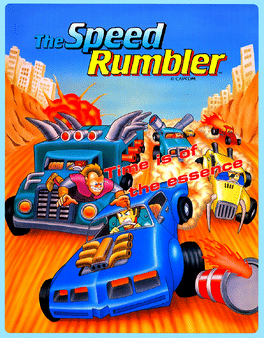
Terrorists have taken Super Joe's family and a number of townspeople hostage. You must drive your gun-equipped car through dangerous streets to free the hostages and collect power-ups. If your vehicle is severely damaged, you may jump free and continue to fight on foot.