Most Popular Atari 8 Bit Games

Boulder Dash
1984
Boulder Dash
1984
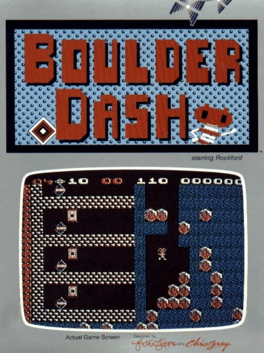
star 7.5Boulder Dash was originally released in 1984 for Atari 8-bit computers. It was developed and published by First Star Software, and spawned a series of sequels, re-releases, and spinoffs. It also did a great deal to establish and influence the mining genre of video games, which can be seen in modern games such as Minecraft, Spelunky, and Terraria.Pong
1992
Pong
1992
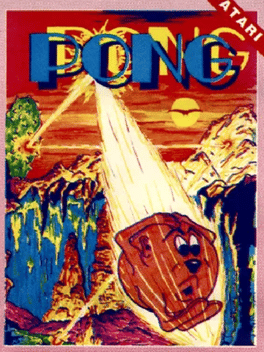
Pong is a platform arcade game. The player controls a ball who has to collect five letters needed to create a password. After collecting the letters Pong will be teleported to his native land. The player moves the ball by setting the direction and strength of bouncing. Pong may use teleporters deployed on the planet. Various creatures and obstacles prevent the protagonist from completing the task.Major League Hockey
Major League Hockey is an ice hockey game. The concessions in comparison with the real game are only four (instead of five) field players and the lack of referee interventions with the exception of the offside rule. Two teams face against each other in a friendly. When the player has the puck, the available actions are to shoot towards the goal or pass to another player. Otherwise is is possible to either check the active enemy athlete or change the controlled athlete, either by automatically going to the one nearest to the puck or making an exact selection. The available options are the length of the thirds (two, five or twenty minutes) and the strength of the computer AI in three steps. The up to four (two on Atari 1200XL) players can be freely divided between the two teams.Encounter at Questar IV
The player controls a small vessel that can move in all directions, and fires a short distance directly ahead. A mobile blue alien and a stationary pink alien continuously fire towards the player, leaving a stream of deadly mines behind. The player must avoid enemy fire and mines to approach and shoot their enemies who later respawn. As gameplay progresses, more mines appear on the screen, making movement difficult. The goal is to maximize the score by shooting as many aliens before losing all 5 lives.Bio-Defense
1985
Bio-Defense
1985
The player is presented with a "scan" of an infected body - you pick one of the grid areas covering the body with the joystick and press the button to switch modes. After that you are a controlling a white blood cell that moves about a field chasing after infections. The object is to eliminate infections from the body.The Bean Machine
1983
The Bean Machine
1983
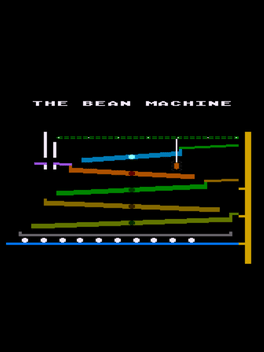
The Bean Machine is a 1-player arcade game for the 8-bit Atari Computer. The bean machine continually picks up beans from a tray on the bottom of the screen, and randomly drops beans at points throughout a maze of moving platforms, monsters, and doors. The player controls 5 platforms with pivot points in the center of the screen, and can rotate the platforms clockwise or counterclockwise. Beans will run along the platforms, and as beans move through the maze, their weight will move the platforms. If beans strike each other, one is destroyed and returns to the starting tray. The goal is to navigate all beans to the collecting tray towards the bottom. There are 3 levels of difficulty, and the goal is to guide all beans in the minimal amount of time.Dangerous Street
1992
Caverns of the Lost Miner
2007
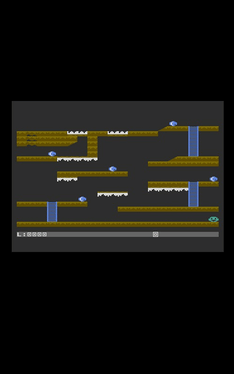
Puzzle game for 8-bit Atari. The player controls a smiling head through a series of increasingly difficult caves. Each cave contains some diamonds. Once all diamonds are collected the player go to the next cave/screen. The gameplay is heavily influenced by Manic Miner. A life is lost if the player hits dangerous objects or surfaces or falls down from the height.Android
1991
Android
1991
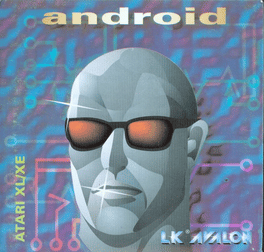
Platform game, set in a space base filled with hostile robots; the player controls a remote-controlled android and must gather spare parts for a computer. The game can be switched between colored and black-and-white mode at any point.Alienbusters
1991
Alienbusters
1991
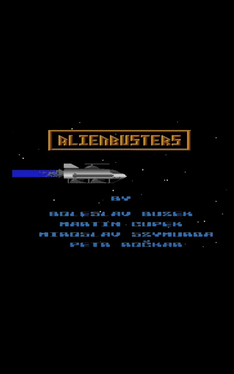
First person shooter for 8-bit Atari PCs. Player controls planetary tank, that has to free solar system from aliens by destroying strategic objects on every planet.Abracadabra
1983
Abracadabra
1983
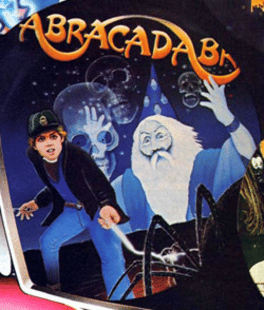
Abracadabra is a simple arcade game starring a young wizard who has to collect keys in the maze-filled wizard’s castle while using a projectile spell to vanquish different enemies such as snakes and elves. One of the features of the environment are the constantly changing walls, ie the individual blocks of the walls change their position as you make your way through. There is also a time limit, failing to exit a room under the given time results in an untimely death. A two-player option is available where two players can take turns and see who collects the highest amount of points.Mr. Robot II
1983
Mr. Robot II
1983
Mr Robot II is the sequel to Mr Robot and His Robot Factory, a platform game created for 8-bit Atari computers by Ron Rosen and released in 1983. The game is about collecting the 100 energy units distributed on the screen.Leaper
1986
Leaper
1986
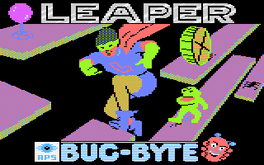
Leaper is based on the game Jumping Jack where you have to get to the top of the screen by jumping through the moving gaps in each level of platforms. In this version the idea is to reach the top of the screen six times, and with each completion, a letter from the word Leaper lights up. You have an energy bar and this decreases if you touch the sides of the screen, don't jump up through a gap cleanly, fall down a gap cleanly or fall down a couple of levels. Once the energy bar is empty then you lose one of five lives. There are also various creatures moving along various platforms and if these are touched then you lose a life.Gauntletak
1987
Avalanche
1981
Avalanche
1981
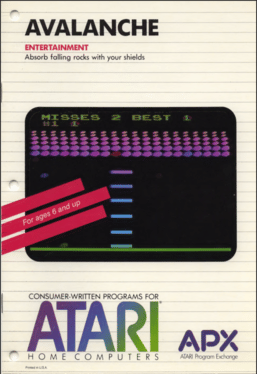
Avalanche is a paddle game of speed and dexterity for one or two players. An avalanche of rocks is poised overhead, ready to pummel you. The object is to score as many points as possible by absorbing the falling rocks with a series of shields before the rocks hit the ground. You maneuver your shields back and forth across the screen by turning the knob of your Paddle Controller. Your chosen bonus level determines the number of misses you're allowed and the number of points you must obtain to earn an extra turn. Compete against your own best score or against another player.Deluxe Invaders
1981
His Dark Majesty
2010
His Dark Majesty
2010
His Dark Majesty is a story driven, turn based strategy game. The player controls units one at a time by selecting them with a cursor, and them moving them into place, attacking or defending other units based on turns left after moving. There are 23 Chapters to the story and 26 units in the base game; an editor was later released that allows users to create their own campaigns. The game is well regarded in the Atari community for pushing the 8bit capabilities; although not fast action, there are good graphics, sound, responsive AI and many hours of content provided on a single disk along with the ability to generate more.