New Games - Page 12359

Project A Part II
1987
Project A Part II
1987
Ma is transferred to work as a police officer to figure out if the allegations of corrupt policemen is indeed true.Sid Meier's Pirates!
1987
Sid Meier's Pirates!
1987
Apple IIGS Commodore C64/128/MAX Atari ST/STE PC (Microsoft Windows) Mac DOS Amiga Apple II Amstrad CPC Nintendo Entertainment Systemstar 7.2You'll criss-cross your way along the 17th century Spanish Main in search of all-new adventures. You'll lead a crew of hot-blooded buccaneers into rollicking harbour towns. And risk your booty and your life plundering enemy ships! Hunt for magnificent treasures! Unravel the mysteries and clues of your adventure! Even battle your way through enemy waters on grueling rescue missions! Will you win your rightful place in history? Or will you end up shipwrecked on a distant island? The answer can only be found in the swashbuckling Pirates! Gold.Knight Games 2: Space Trilogy
1987
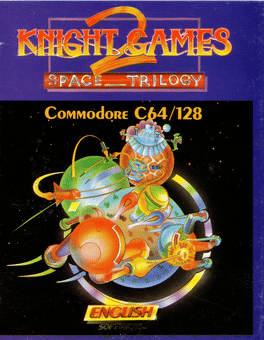
Knight Games 2: Space Trilogy is the sequel to Knight Games. Set in the year 3002, it consists of three different futuristic games: "Combat Robot", "In Orbit" and "Final Tournament". Combat Robot: Based on Dropzone, the player controls Robby the Robot in a two-way horizontal scrolling game. The goal is to pick up friendly robots while blasting enemies. Once a robot is picked up he can be taken back to base and dropped. In Orbit: Flying about Earth in another two-way horizontal scrolling game, the player has to blast enemy ships while trying to load supplies in orbit over the planet. The game then switches to a 3D view behind the player's ship as it heads for the loading bay. Final Tournament: Reminiscent of the first game, this part is a competition in three events of armed combat: Jet Joust, Light Sabres and Photon Chains. Each event is viewed from the side on a single screen. The goal is to defeat one's opponent and get a high score. This part can be played by one or two players.The Lurking Horror
1987
The Lurking Horror
1987
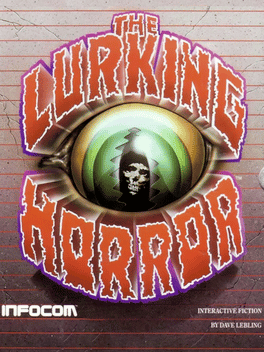
The Lurking Horror is an interactive fiction game released by Infocom in 1987. The game was written by Dave Lebling and inspired by the horror fiction writings of H. P. Lovecraft (including his Cthulhu Mythos). Like most of Infocom's games, it was released for several platforms simultaneously thanks to the Z-machine. The original release included versions for DOS, the Apple II, Atari ST, Atari 8-bit family and Commodore 64. Later, it was ported to the Amiga with the addition of sound effects, making it the first title with that feature. The effects would play at appropriate times in the game in an effort to intensify the horror atmosphere. This marked one of the few major additions to the Z-machine with the exception of graphics; traditionally, Infocom had eschewed such changes in favor of expanding the parser capacity and overall size of game files. It was Infocom's 26th game; Infocom rated it as "Standard" in terms of difficulty. Lurking Horror was the only horror game ever released by Infocom.The Great Giana Sisters
1987
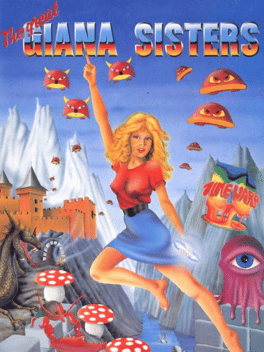
star 8.2The Great Giana Sisters is a side-scrolling platform game originally released in 1987 for various home computers. Players control Giana, navigating through levels filled with enemies, hazards, and hidden items. The goal is to reach the end of each stage by jumping across platforms and avoiding obstacles. Power-ups, such as the ability to break blocks or shoot projectiles, aid in progression. The game is known for its strong resemblance to Super Mario Bros. in both gameplay and design.Wizardry: The Return of Werdna - The Fourth Scenario
1987
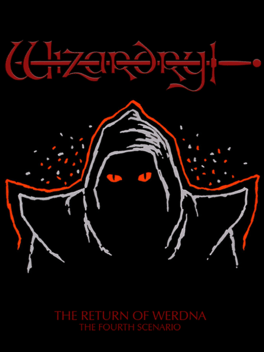
The fourth game in the Wizardry series, The Return of Werdna takes a decidedly different approach from all the games that preceded it. Instead of playing as a party of six player-generated characters, the player controls Werdna himself, the evil Archmage from the first game. It seems that after Werdna was defeated by the party of adventurers who stole his amulet, he was imprisoned at the bottom of his ten-level labyrinth in an eternal slumber to be tortured by nightmares for eternity. Although Werdna was supposed to sleep forever, somehow he has awakened, and now he is out for revenge. At the beginning of the game Werdna finds himself in a situation that is singularly unique for most arch-villains: he is stripped of his powers, trapped within his own former stronghold, and filled with the realization that the same traps and monsters he created to keep adventurers out now act as obstacles to his freedom. Werdna will slowly regain his magical powers as well as have the ability to summon helpful monsters to accompanSanma no Meitantei
1987
Sanma no Meitantei
1987
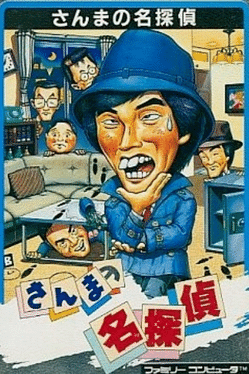
Sanma no Meitantei is a murder mystery detective adventure game developed and published by Namco for the Famicom in 1987. In the vein of Portopia Renzoku Satsujin Jiken, the player must visit several locations associated with the murder victim, to discover clues which will open up more locations in order to find more clues until ultimately, the identity of the murderer can be confirmed. The game is played entirely in Japanese and was never translated into English. The summary of the story is that while the president Yoshimoto held a party at his villa, Katsura Buntin was found to have been killed in the vault. On top of that, the "Star of Africa" diamond that was stolen from the vault. As detective Sanma Akashiya's assistant, you must help him determine the perpetrators of the incident. The game features a mini game which is a parody of Galaxian, and contains sound effects from other Namco hits such as Dig Dug and XeviousDanger Street
1987
Danger Street
1987
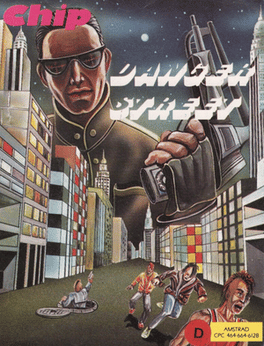
Danger Street is an arcade game set in New York 2017, a superb city filled with most infamous criminals in the entire galaxy. The highest council of New York has decided to finish it once and for all and massively eliminate these scums. The player is the vigilante of the future, who must rid the city of all these decadent beings. New York is counting on you! So, the player should shoot the enemies appearing on the screen and shooting at you with an aiming crosshair while scrolling the street from left to right. Once all the enemies are eliminated on the level, the player is transferred to the next level gaining the scores and the bonus. There is no health bar, and it is only one life for the player.Fairy Tale
1987
Fairy Tale
1987
Hero has been keeping an eye on the pretty girl Yumiko-chan and now succeeds now in getting in her apartment impersonating himself as a gas company staff member. On the pretext of a regular check-up he searches the kitchen for useful items and then approaches Yumiko with an intention to get in her pants.A lenda da Gávea
1987
A lenda da Gávea
1987
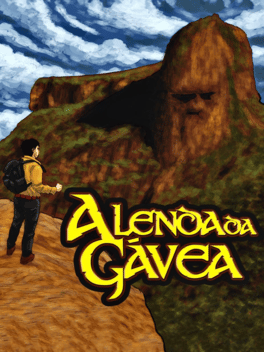
A lenda da Gávea is a science-fiction text adventure game about exploring the Pedra da Gávea mountain and its secrets.Han Seimei Senki Andorogynus
1987
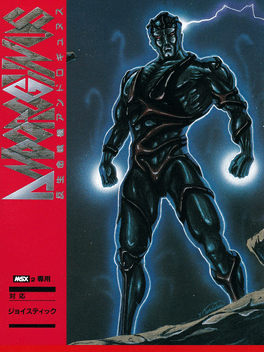
Andorogynus is a top-down shoot-em-up. The player controls the titular hero(ine), shooting at constantly attacking enemies. Unlike in most games of the type, the screen scrolls down rather than up. The protagonist is equipped with a default single shot and has protective orbs revolving around that damage nearby enemies. The weapon can be enhanced (rapid fire, three-way fire, etc.) by collecting randomly descending power-ups. The player controls the male incarnation of the protagonist initially, but later switches to the female one.Monitor Puzzle Kineko: Kinetic Connection Vol. II
1987
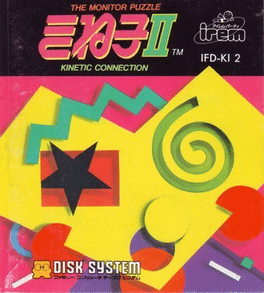
An image puzzle game and the follow up to the original Kinetic Connection. It was developed by Tamtex and published by Irem for the Famicom Disk System. Kinetic Connection Vol. 2 (or Monitor Puzzle Kineco: Kinetic Connection Vol. 2 to give it its full title) is a follow up to Tamtex's Kinetic Connection, featuring more animated pictures to craft from composite pieces similarly to a jigsaw puzzle. As with its forebear, the trick to Kinetic Connection Vol 2 is to closely observe the moving parts in each of the pieces as the animation goes through its loop in order to glean hints as to where each piece belongs. Though very much simply more of the same, the new puzzles have some interesting ideas behind them. The hardest puzzle happens to be a Defender-like game that responds to the player's movements as they try to assemble the puzzle.Laurel & Hardy
1987
Laurel & Hardy
1987
Laurel & Hardy stars the two famous comedians in their quest to throw cream cakes in each others face. The interface is divided into three horizontal parts: the middle one shows the match statistics and the possessions while the other two represent the town from the side. The first order of business is finding the cream cake shop to get ammo. For finding the way in the big city, it is recommended to purchase a map. Various items on the way may help or bring disadvantages, e.g. a bike to become faster (but are forbidden in certain parts of the city) and liquor bottles (soda is good and beer is bad). After a successful hit a point is rewarded and after one has a certain number of points (can be specified before starting the match) he wins.Kozure Ookami
1987
Kozure Ookami
1987
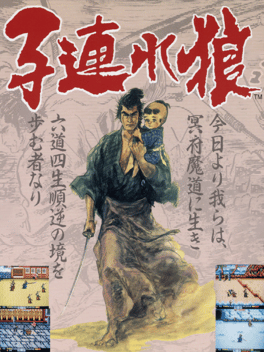
Game based on Lone Wolf and Cub. After Ogami Ittō's wife Azami gives birth to their son, Daigorō, Ogami Ittō returns to find her and all of their household brutally murdered, with only the newborn Daigorō surviving. The supposed culprits are three former retainers of an abolished clan, avenging the execution of their lord by Ogami Ittō. However, the entire matter was planned by Ura-Yagyū (Shadow Yagyu) Yagyū Retsudō, leader of the Ura-Yagyū clan, in order to seize Ogami's post as part of a masterplan to control the three key positions of power: the spy system, the official assassins and the Shogunate Decapitator. During the initial incursion, an ihai (funeral tablet) with the shōgun's crest on it was placed inside the Ogami family shrine, signifying a supposed wish for the shogun's death. When the tablet is "discovered" during the murder investigation, its presence condemns Ittō as a traitor and thus he is forced to forfeit his post.Challenge of the Gobots
1987
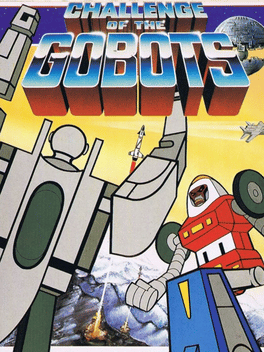
Ariolasoft produced this game based on the then-sort-of-popular cartoon series, Gobots.Stationfall
1987
Stationfall
1987
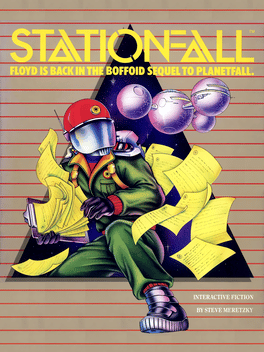
Stationfall is an interactive fiction computer game written by Steve Meretzky and released by Infocom in 1987. Like the majority of Infocom's works, it was released simultaneously for several popular computer platforms of the time, such as the Commodore 64, Apple II, and PC. The game is a sequel to Planetfall, one of Infocom's most popular titles. It is Infocom's twenty-fifth game. Following the events on Resida in Planetfall, the player's character received a promotion from lowly Ensign Seventh Class to Lieutenant First Class. The life of an officer in the Stellar Patrol is no better than that of a humble enlistee, however. Five years after the thrills of saving an entire planet from destruction, the character is stuck in a boring desk job that demands piles of tedious paperwork instead of menial cleaning duties. A typically boring assignment comes in: accompany a spacetruck to a space station and pick up a load of "Request for Stellar Patrol Issue Regulation Black Form Binders Request Form Forms". To make thing