New Games - Page 12213

Arctic
1989
Arctic
1989
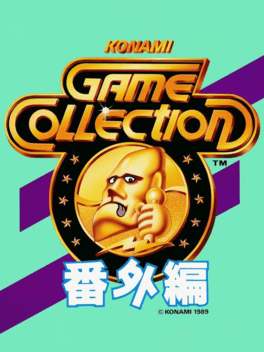
Arctic is an action puzzle game that describes itself as "active rail playing". Each of more than two-dozen stages consists of a set of rails in various arrangements, often looping around each other and splitting in various directions. Each stage contains a number of colored balls which begin in corresponding slots, and after launching them the goal is to return the balls to the matching-colored slots. The only interaction the player has with the board is switching two sets of splits; there are yellow and blue splits, which will redirect any balls moving through them, and the player can only turn all of one color as a group. Many stages also contain bumpers and gates which will affect the speed and direction of the balls. Completing a puzzle often requires strategic use of the stage's features to bounce balls onto the correct paths.Konami Game Collection Bangai-hen
1989
This is the fifth of five Konami's Game Collections released on a 3.5" diskette. This Extra edition has the following MSX-1 games: - Pippols - Hyper Rally - Road Fighter These collections where only ever released in Japan, and as such the menu to select the game is in Japanese. But the actual games will display the same as the original releases. Compared to the original releases, these games have enhanced SCC+ music, when used with the 'SCC+ Sound Cartridge' from the Konami game 'Snatcher' or 'SD Snatcher'. In addition this Extra edition has some unique MSX-2 mini games; Single Player Games: - Tsururin Kun (steal rice balls) - Hyper Somen (catch rice) Party Games: - Title Awase (Memory game) - Go BoardGraphic Adventures
1989
Graphic Adventures
1989
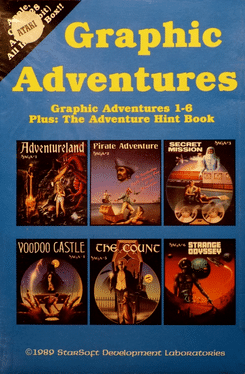
Compilation, of the six graphical versions of the original Scott Adam's all-text adventures, that was published by Starsoft Development Laboratories for the Apple II, Atari 8-bit and C64 platforms.Kingdoms of England
1989
Regnum
1989
Verminator
1989
Fallen Angel
1989
Fallen Angel
1989
Fallen Angel is a side-scrolling action game where players control a divine warrior tasked with dismantling a global drug syndicate. Starting in London's underground rail system, players navigate through multiple train stations, fighting thugs and bosses using hand-to-hand combat and occasional weapon pickups. Each level requires finding a plane ticket to progress and defeating a local crime boss, with players free to explore stations in any order via the subway system. The game's nonlinear structure allows players to tackle objectives as they choose while progressing through an international criminal underworld.Don't Go Alone
1989
Don't Go Alone
1989
Don't Go Alone is a horror role-playing game. The player can choose their party from a variety of 16 paranormal characters available. With their party they'll investigate a haunted house on a hill. The house is huge and players will encounter over 100 spooky opponents and solve various puzzles in order to find out the mysteries of the haunted house. An automap feature helps prevent the player from loosing track in the huge dungeons of the game.California Pro Golf
1989
California Pro Golf
1989
A hole in one - A 270 yard drive - A five Iron shot within 5 feet of the pin, - A single putt! No you are not dreaming it's just another round of golf on a sun-soaked California links course! Should you fade, draw or hit under the wind? Should you punch your approach shot onto the green? These are just some of the options and features crammed into this superb golfing simulator.DeathTrack
1989
DeathTrack
1989
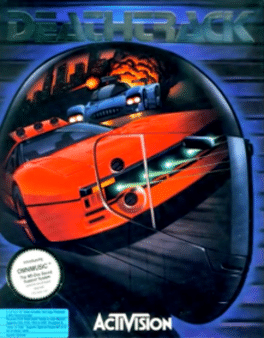
There are two ways to win a race: be the first, or be the only one. Based in a futuristic America, the player races on various tracks across the country for money, which can be spent on armor, weapons and other modifications to protect and use against the competition. The player chooses from one of three cars (either "The Hellcat" for high speed, "The Crusher" for high firepower or "The Pitbull" for heavy armor).Aldo Again
1989
Aldo Again
1989
Aldo Again is a single player clone of Donkey Kong. The objective of the game is to take Aldo to the treasure chest, avoiding falling barrels along the way. When the chest is reached any remaining time is added to the player's score. Time is an important resource and playing time can be extended by picking up prizes en-route. The game is entirely keyboard controlled.3D Block
1989
3D Block
1989
This is an adaptation of Blockout, which in itself is a 3D version of Tetris. This is emphasized with the cartridge itself, having the artwork ripped from the original game. In this version the well is 5x5x10 cubes large and the size never changes, unlike the official versions. The controls are somewhat unorthodox, as unlike most other games, the Select button pauses the game while Start speeds up the block so that it moves to the bottom of the well faster. The block designs themselves are the same as in the arcade version of Blockout.Yasuda Fire & Marine: Safety Rally
1989
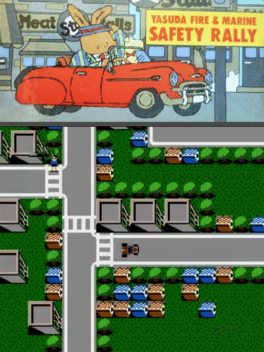
This game was not sold in stores but rather it was distributed by the Yasuda insurance company in 1989.Crime Busters
1989
Crime Busters
1989
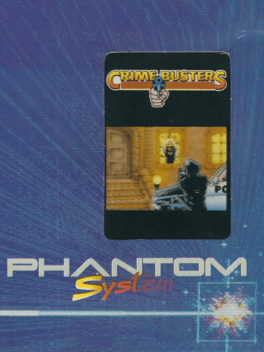
Crime Busters is an Action game, developed and published by Bit Corp., which was released in Asia in 1989. It was also released in Brazil, for the Phantom System NES clone.Tagin' Dragon
1989
Tagin' Dragon
1989
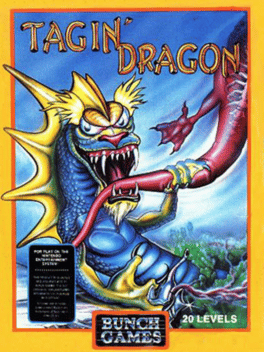
20 challenging levels! Play tag with maze after maze full of dragons. Only a dragon's tail is vulnerable, so sneak up from behind and munch till they turn to bones! If you are fast enough to snatch the magic lantern, you can discover the secrets buried within the walls of each maze.Raid 2020
1989
Raid 2020
1989
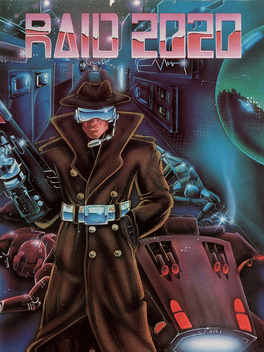
The year is 2020 A.D. The evil drug kingpin Pitbull and his army of robots and brainwashed servants have crippled the law enforcement agencies of the world. You must seek out and destroy his communication and computer centers thus putting an end to his evil network of shipping and distribution. As you confront Pitbull's dealers and robotic "Cyborg" servants you will seize their drugs and money. The money will enable you to purchase the tools needed to overcome the obstacles in your path. Don't let the beauty of the streets fool you, for you are about to enter a world of laser beams, exploding mines and secret entrances. Engage your enemies as you traverse through the Pier, the Streets of Technopolis, and the Warehouse searching for clues. You will encounter more danger as you pilot a boat across the Swamp and travel through Space to an eventual confrontation with Pitbull himself in the Computer Center!Little Red Hood
1989
Little Red Hood
1989
This is no ordinary forest. Then again, this is no ordinary Little Red Riding Hood. She can sure throw a kick, and let me tell you, she needs it to get to grandma safely. The forest is filled with wicked goblins, snakes, scorpions, bears and of course, the WOLF. Team up with her faithful dog and help LITTLE RED RIDING HOOD collect fruit, candy and magic potions so that she can fight these evil beasts and save grandma!Master Chu and the Drunkard Hu
1989
Return to a mythical time in the Far East, when the legendary Siamese-Twin Shiva, God of Destruction, cursed your village with fearsome evil spirits. Despaired by repeated failures to drive out Shiva's evil demons, your best friend, Master Hu, has turned into a drunkard. You, Master Chu, must search through hostile palaces and temples to find and destroy this four-armed incarnation of Shiva. If you would like, just ask your teammate, the Drunkard Hu, to help out. Playing together can be a lot of fun!Jovial Race
1989
Jovial Race
1989
It was an ordinary bright and sunny day, then something out of the ordinary happened, since, with that "Jovial Car," anything can happen! I'm not going to tell you everything. You better come with me to experience this once-in-a-lifetime trip. If you collect all the flags in a round, then you will advance to the next world. You can drive to the shopping mall for shopping, but don't forget to press your "Start" button before you make your purchase! Asia releaseBaby Boomer
1989
Baby Boomer
1989
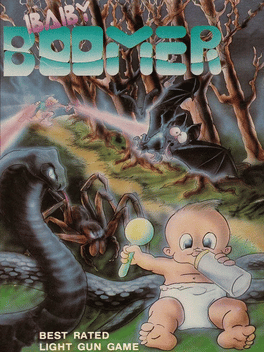
One day while nobody was looking, Baby Boomer climbed out of his crib and headed into the woods. Little did he realize that while he's enjoying this adventurous journey into the unknown, there are many dangers awaiting him! Your job is to use your Zapper to protect Baby Boomer and help him find his way home to his mother. Unlike other Zapper games, you can shoot just about anything you see in Baby Boomer. Some things give extra points, while others give extra lives, open secret passages, control something in another part of the world or clear a safe route for Baby Boomer to follow.