New Famicom Games - Page 37

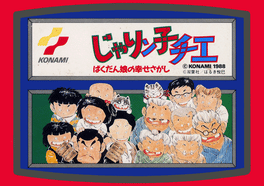
Jarinko Chie: Bakudan Musume no Shiawase Sagashi
1988
"Jarinko Chie: Bakudan Musume no Shiawase Sagashi" is a graphical text-adventure game. It is a game based on the Jarinko Chie anime and manga about a dependable girl who struggles to help her troublesome father run a small tavern in Osaka. Unbeknownst to her dad, she occasionally visits her mother who left him not too long ago. She plans on trying to reunite them, but not until her father gets a job. Though it is largely text driven, there are moments where the player must play a mini-game in order to advance to the next chapter of the story.Dragon Ball: Daimaou Fukkatsu
1988
Dragon Ball: Daimaou Fukkatsu is a role playing video game released only in Japan by Bandai on August 12, 1988. It is the second Dragon Ball video game released for the Nintendo Famicom. Daimaō Fukkatsu is the first role playing game based on the Dragon Ball series. Its gameplay was reused in the Goku-den video game series. Daimaou Fukkatsu is also one of the games included in the game compilation J Legend Retsuden for Nintendo 3DS.Soccer League: Winner's Cup
1988
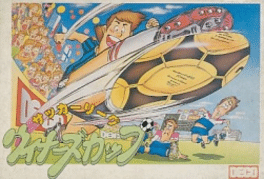
Soccer League - Winner's Cup is a soccer game developed by SAS Sakata for the Famicom, and published by Data East in 1988. During game play, field scrolls horizontally across the screen. Players select one of eight international teams and attempt to win the World Cup. The teams that the player can select include: Japan, Germany, Brazil, France, South Korea, England, Argentina, and the USA. Players may choose to play solo against the computer, or compete head to head with another player. Although the game was never released outside of Japan, most of the options are written in English.Mito Koumon II: Sekai Manyuu Ki
1988
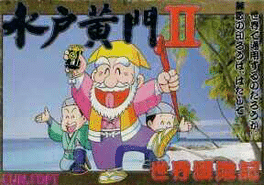
A NES action game developed by SunSoft and the sequel to Mito Koumon. It was never released outside of Japan. Mito Koumon II: Sekai Manyuuki is the sequel to Mito Koumon and is very similar in appearance and gameplay. As in that game, the player controls one of Mitsukini Tokugawa's retainers as they gather clues and evidence of crimes in the area while either avoiding or fighting off hostile NPCs. Unlike the first game, which was set entirely within Japan, Tokugawa is crossing the world solving issues instead. The first stage is America (specifically the Wild West, as would be chronologically accurate for the 17th century) though there are plenty of other locations to visit across the world as well, including even Transylvania.The Money Game
1988
The Money Game
1988
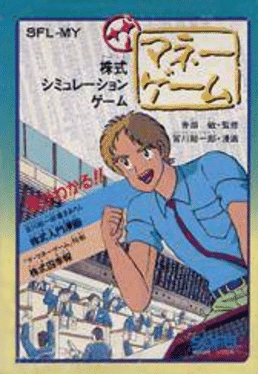
A Stock Market/life-sim game where the player must manage their stocks in order to achieve a happy life. It was developed by SOFEL for the NES and released in Japan only. The Money Game is a stock market simulation game where the goal is to raise money through the wise purchasing and selling of various types of stock. Coupled to this is a life-sim aspect where raising a sufficient amount of money at certain checkpoints allows the player to gain and keep a girlfriend, who later becomes their wife and provides children. As well, the player can upgrade from their initial studio apartment to a terraced house to a mansion with its own Olympic-sized swimming pool. The game is densely packed with Japanese script and requires both literacy in that language and a fairly good understanding of dealing in the stock market itself (though the game does provide tutorials for the latter). It would be followed by a sequel, The Money Game 2: Kabutochou no Kiseki, which in turn would be the basis for SOFEL's Wall Street Kid.Tatakae!! Ramen-Man: Sakuretsu Choujin 102 Gei
1988
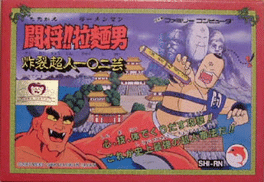
Tatakae!! Ramen-Man: Sakuretsu Choujin 102 Gei is an adventure game developed by Human Entertainment for the Famicom and published by Bandai in 1988. It is based off the Tatakae!! Ramenman series, which itself is a spin-off of the Kinnikuman series, known in the US as M.U.S.C.L.E.. Ramenman is a popular character in the Kinnikuman universe. The game follows the eponymous warrior Ramenman as he attempts to track down his father's killers and bring them to justice with his many years of martial arts training. Notably, this game is the first true point-and-click adventure game for the system. While there had been many adventure games made for the NES, such as Portopia Renzoku Satsujin Jiken or Princess Tomato in the Salad Kingdom, they are largely driven by menus. Ramenman is directed by using the cursor to select an area to walk to or interact with instead much like classic Sierra adventure games such as King's Quest.Eggerland: Meikyuu no Fukkatsu
1988
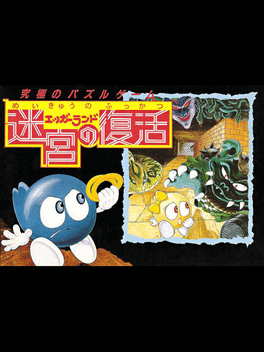
Eggerland: Meikyuu no Fukkatsu is a puzzle video game developed by HAL Laboratory for the Family Computer. It was released in 1988 in Japan as the fourth game in the Eggerland series following Eggerland Mystery, and is the third in the series not counting the port of Eggerland 2 made for the Famicom Disk System. The game contains roughly 162 stages (or maps), which are arranged on an 8-by-16 grid (with some stages hidden).Kakefu-kun no Jump Tengoku Speed Jigoku
1988
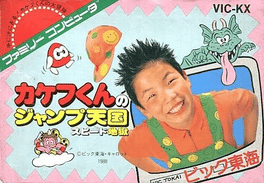
A video game released for the Nintendo Entertainment System in 1988 by Vic Tokai. The game's main character is based on Kenji Sagara (相良 健治, Sagara Kenji), a popular Japanese child actor who was famous in the 1980s for his impersonation of baseball player Masayuki Kakefu.The Best Play Baseball Special
1988
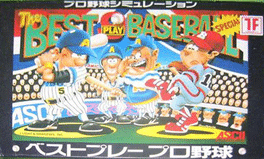
A Japanese baseball sim developed by ASCII for the NES. It focuses more on team management than playing the sport itself.Super Black Onyx
1988
Super Black Onyx
1988
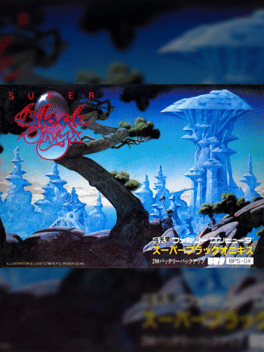
Super Black Onyx is an RPG developed by Bullet Proof Software for the Famicom and published in Japan in 1988. It is an expanded version of the game The Black Onyx, which includes the ability to cast spells, more monsters, and a larger dungeon to explore. It also enhances the presentation of the graphics beyond what was standard for the computer versions at the time, and simplified the controls to be played with a control pad.Saint Seiya: Ougon Densetsu - Kanketsu-hen
1988
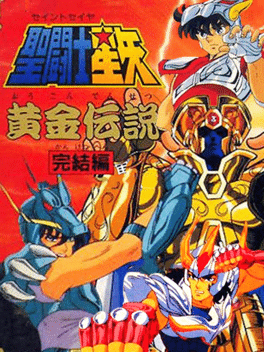
Saint Seiya: Ougon Densetsu - Kanketsu-hen is an RPG based on the anime and manga series Saint Seiya. It was developed and published by Bandai in 1988 for the Famicom as a sequel to the first Famicom Saint Seiya game, Saint Seiya: Ougon Densetsu. This version picks up where the first game left off, with the Bronze Saints about to take on all twelve of the Gold Saints in order to save Saori before time runs out. The game remains faithful to the original story, to the extent that your options are limited if you try to choose match-ups that didn't occur in the show.Sangokushi: Chuugen no Hasha
1988
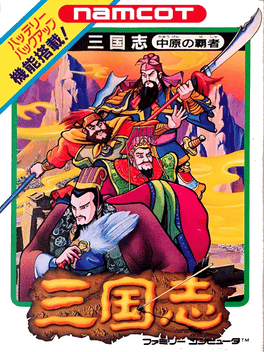
A war strategy game that focuses on the Ancient Chinese Three Kingdoms conflict. It was developed by TOSE and published by Namco for the NES.Kyuukyoku Harikiri Stadium
1988
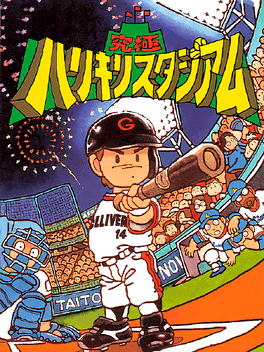
Kyuukyoku Harikiri Stadium is a baseball game developed by Taito Corporation. It was published in Japan for the Famicom in 1988. It is the first of the series of baseball games that was informally known as "Harisuta", which saw four games published for the Famicom, and two more for the Super Famicom. The starting entry contains 13 teams, 12 of which are modeled after real Japanese teams, while a 13th team (the I team) consists of a team of women players who represent various idols or models who were popular at the time. The game features a single player mode against the computer, a head-to-head mode for two players, or a home run mode where you compete to see who can hit the most home runs. Before the end of 1988, a version of the same game was released with an updated player roster, under the title Kyuukyoku Harikiri Stadium '88 Senshuu Shin Data.Sanada Juu Yuushi
1988
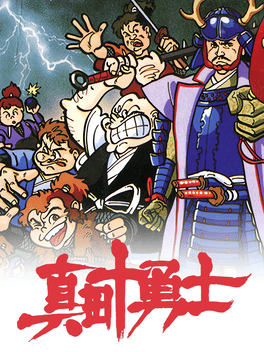
Sanada Juu Yuushi
1988
An RPG published by Kemco for the Famicom. It was never released outside of Japan. Sanada Juu Yuushi (roughly "Sanada Ten Braves") is a Sengoku era themed RPG featuring ninjas. The Sanada in question is Yukimura Sanada, the second son of one of the more important daimyos (feudal lords) of that era, who is purported to have had ten legendary ninjas helping his war efforts - the same ten braves referred to by the game's title. The game's general plot has Sanada finding and recruiting the titular ten braves, usually with the caveat that the player helps them with a task before they'll agree to join the party. The menu-driven RPG battles are a little unusual as each is a one-on-one battle with a singular opponent - however, the player is free to choose from any of the characters they've already recruited, changing the character in the subsequent round if they so wish.Namco Classic
1988
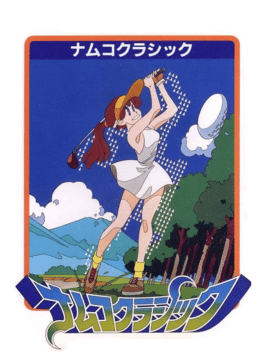
Namco Classic
1988
Namco Classic is a golf game developed by Namcot and published for the Famicom in 1988. The game features Round Play, which you can use to practice the course in the game or compete with friends, or Tournament mode, where you play against a computer opponent in an effort to win a large amount of prize money. The game was also released for the Game Boy in 1991. The Game Boy version features a different course but is very similar in many respects. In 1996, that version was also included in the compilation title, Namco Gallery Vol. 1.Kamen no Ninja Akakage
1988
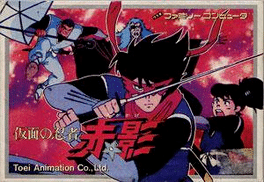
Kamen no Ninja Akakage is an Action game, developed by Shouei and published by Toei Animation, which was released in Japan in 1988.Meitantei Holmes: Kiri no London Satsujin Jiken
1988
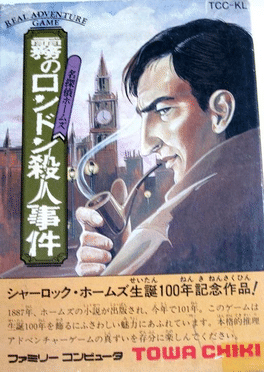
An adventure game starring Sir Arthur Conan Doyle's Sherlock Holmes developed for the NES by Towa Chiki. Meitantei Holmes: Kiri no London Satsujin Jiken ("Great Detective Holmes: Fog of London Murder Case") is a murder mystery adventure game where the player directs Sherlock Holmes around London, finding clues and interrogating witnesses and suspects. Like its many NES adventure game contemporaries, it adheres to the Portopia formula of text adventure whodunits. It is the sequel to Towa Chiki's earlier Sherlock Holmes game (Sherlock Holmes: Hakushaku Reijou Yuukai Jiken) and received a sequel (Meitantei Holmes: M-Kara no Chousenjou). None of these games were ever released outside of Japan.Deep Dungeon III: Yuushi he no Tabi
1988
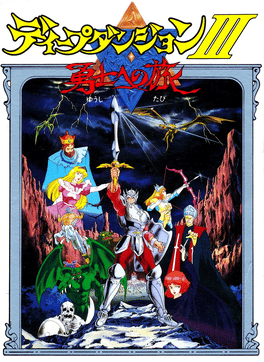
Deep Dungeon III: Yūshi he no Tabi is the third installment in the Deep Dungeon series and the first to be released on the Famicom. This is the first Deep Dungeon title to offer the player a world to explore spanning multiple dungeons and multiple towns. It also allows the player to create their own party with up to three companions in addition to the hero character, with a choice of ranger, magician or priest for each character. Though the player can dismiss a character once the game has started, they will only be able to replace that character if they meet another pre-created playable character in one of the dungeons. However, the game will still end as soon as the protagonist "swordsman" character is defeated. This game retains the player-adjustable level-up stats from the first game, as well as the feature that removes randomized encounters if the player is at a significantly higher experience level than needed for their current location. One exclusive and rather annoying feature of this game engine is that soDokuganryu Masamune
1988
Dokuganryu Masamune
1988
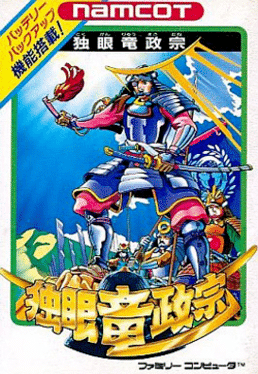
Dokuganryu Masamune (独眼竜政宗?) is a historical simulation game developed and produced by Namco for the Famicom in 1988. It is the third such game to appear on the Famicom inside of a month, including Koei's Nobunaga's Ambition and HOT-B's Takeda Shingen. This game is based on the life of Date Masamune, who held power in Japan during the early Edo period. An outstanding tactician, he was made all the more iconinc for his missing eye, and Date was often called dokuganryu (独眼竜? one-eyed dragon). In the game, you play as the warring overlord, and your aim is the unification of 11 regions under one rule. While comparable to other historical simulations released around the same time, this game is a little simpler and features immediate battle scenes, a hexagonal map, and includes mini-games such as a gold mine search and horseback archery. The game keeps a light, almost humorous tone, providing updates in the game via the Namcot newspaper, which shows changes in conversation tone and the emotions of your oFleet Commander
1988
Fleet Commander
1988
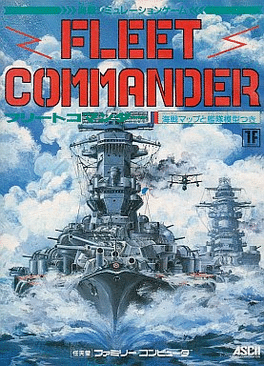
Fleet Commander is a strategy game developed and published by ASCII Entertainment for the Famicom in 1988. It is the first naval battle game ever released for the system. While it supposedly depicts a battle between two fictional countries, the game is largely recognized to be a recreation of one of the crucial naval battles that occurred between Japan and the United States near the end of World War II. Players control a Japanese fleet of heavy cruisers, battleships, submarines and aircraft carriers. A couple of things set this game apart from typical Famicom games. First, in addition to the cartridge and the manual, the game also came packaged with a large map and plastic models which represented ships and airplanes. The game never shows the entire state of the water, so it is up to the player to use the information that he or she has to update the representation of battle on the map using the plastic models. Second, no background music is heard while playing this game. Finally, this game makes use of a device kn