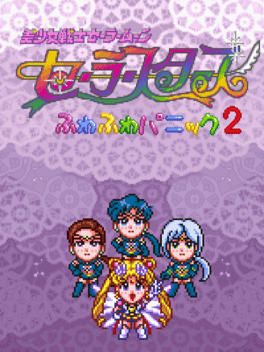
The second game in the Nazoler Land series of minigame compilations published by SunSoft for the Famicom Disk System.
Nazoler Land Dai-2-gou is the sequel to Nazoler Land Soukan-gou and is similarly a minigame connection with a magazine theme. It contains six minigames, rather than its predecessor's eight. A notable feature of this compilation is that all the minigames are represented as Famicom disks on the select screen, and once a game is chosen an animation shows the disk being loaded in the Famicom Disk System.
The minigames include:
Patalick
A panel-switching puzzle game that shares some similarities with Q*Bert (specifically, switching panel colors and the isometric perspective) but is far more cerebral and less active in nature. The goal is to use the shape-shifting protagonist (who transforms from an angel to a devil form) to switch all the panels on the screen to the same color, keeping in mind that every panel in a horizontal and vertical line will flip over.
Geographic Nazoler Quiz
Like the transpor
The third and final core entry in the Nazoler Land series of minigame compilations with a magazine theme. It was developed and published by SunSoft for the Famicom Disk System.
Nazoler Land Dai-3-gou is the third game in the Nazoler Land series. Like its predecessors, it was developed and published by Sunsoft for Nintendo's Famicom Disk System in Japan only, and contains various minigames with diverse gameplay.
These minigames include:
Sugoro Quiz
All three Nazoler games had a quiz minigame of some kind, but Sugoro Quiz is the first to emphasize a multiplayer aspect. Two to four human players compete in a board game in which players progress by answering trivia questions.
Tomo Bakuso
The second minigame starring the schoolgirl Tomo, after Nazoler Land Dai 2 Gou's Blast Tomo. In this game, she is trying to pass through a level of platforms, some of which will block access after being passed through a certain number of times.
Tanteidan Boy Nazoler
An early example of an "escape the room" adventure game, which wo
A mini-game compilation from SunSoft for the Famicom Disk System. It is the first in a series of four Nazoler games.
Nazoler Land Soukan-gou is the first in a series of minigame collections from SunSoft developed especially for Nintendo's Famicom Disk System peripheral. It was followed by two direct sequels and a quiz-based spin-off.
Nazoler Land Soukan-gou (or Nazoler Land Vol. 1) has eight minigames that the player can select from a menu after loading the game up and switching the disk around. These are:
Rotation Maze
A maze-like puzzle game where a small circular being has to pass through a maze filled with dividers. The player can only pass through these dividers if there is room for it to turn around, otherwise it blocks the player's progress. The goal is to find the correct path through the maze.
Nazoler Fortune-Telling
Despite using signs of the Zodiac and suggesting a fortune-telling aspect, the game is actually a variant on the classic strategy board game Mastermind: The goal is to find the right combi
Puzzle Boys is the second game in the Puzzle Boy series of 5 games. The first game is the most well known, released as Kwirk on the GameBoy in North America. This is Atlus’s only FDS game, and a late one at that, as the FDS was pratically dead by the time the GameBoy came out. This game improves on Kwirk by adding color, a really fun two player on the same screen mode with the ability to handicap the better player, and way more puzzles in Puzzle Challenge Mode, 80 vs. Kwirk’s 30.
An image puzzle game similar to a jigsaw puzzle, except the picture it creates is animated. It was published by Irem in Japan only for the Famicom Disk System.
Kinetic Connection, which has a longer title of Monitor Puzzle Kineco: Kinetic Connection for its original FDS release, is a puzzle game in which the player has to assemble a picture from a number of pieces like a jigsaw. However, the image (and thus the smaller pieces of the image) is constantly moving as it loops through an animation: This makes putting the puzzle together even more complicated, though it's occasionally made easier by carefully watching how pieces interact with each other.
The game was developed by Tamtex, a subsidiary of Irem that made computer games, and published by Irem in Japan. The game would be later ported to the MSX and C64 home computers, as well as on the Sega Game Gear. It was also followed a year later with a FDS-only sequel, Kineco II, which was only available via the Disk Writer service.
Michael English Daibouken is an educational game where the character of Michael, an orange cat, teaches kittens the various letters in the English language as well as some English vocabulary. Michael has to catch floating letters in order to spell out English words, while avoiding the incorrect letters. The game has various different backdrops, including space.
The character of Michael comes from the Japanese serial manga strip "What's Michael", created by Makoto Kobayashi which might be considered analogous to Garfield, due to them both being orange cats. It varies between observing goofy pet behavior to more abstract tales of fantasy with anthropomorphized versions of the animal characters.
One month a year, we celebrate this season, thank you for the wonderful memories.
And in appreciation for this year, while people send the gifts, Christmas is for us a time to round off the memories of one year, a time to give those close words of gratitude in a Christmas card.
Thank you for the wonderful memories this year.
With feeling of gratitude, our gift to you.
Merry Christmas.
The classic game of Hangman, in which the player has to guess a hidden word by suggesting letters. Only a certain number of letters can be tried - every incorrect guess will add an element to a drawing of a man being hanged at the gallows. The player loses if the drawing gets complete, due to his missing attempts at finding the letters in the secret word.
The game contains 64 game variations of this basic premise for either 1 or 2 players, with or without a score. Variations include:
The computer selects the word to guess;
One player comes up with a word for another player to solve;
The player is given one of the letters in the word to help him get started;
The game will tell the player he guessed the right letter but will not say where it belongs in a word;
The player isn't told how long the secret word is;
The player has to guess the letters and their location in the word;
The player has to solve an anagram.
A game of gomoku against girls whom strip off clothes if you win. The game's AI is rather hard to beat, but sometimes it makes glaring tactical mistakes.
To shortly sum up Monkey Business, it's about educational and math / logic, puzzle-solving. You have 3 -5 monkeys who have to stack on top of each other to capture an apple. there are only 3 spots to fill. For the generation growing up in the 80s it was often the first computer game ever played as it was exstenivley used in schools. It was made by Learning Technologies, Inc. in 1986
Slide the tiles around the board and collide identical numbers in order to climb up the power-of-two series until you achieve 2048. Each turn a new '2' or '4' stone will appear on the 4x4 grid, meaning that you'll have to choose your moves carefully. Every time you collide two or more tiles, your score increases by their merged value.
Originally an entrant in RGCD's 2014 C64 16KB Cartridge Competition, this final commercial version of the game features further visual improvements and minor bug-fixes (such as same speed music played on PAL and NTSC systems).
An updated rework of an unreleased game that Nils Hammerich originally completed over 20 years ago, GRAVITRIX brings arcade-style, mind-bending puzzle-action to your Commodore 64 like never seen before!
Combine stones of four different gravity directions to solve each of the 120 levels across six themed worlds, but be wary of colour changers, conveyor belts, teleporters and other hazards!
To complete each level, you must clear the screen of all of the coloured GRAVITRIX stones. ALL of the stones of EACH colour must be connected in a single 'group' in order for them to vanish, ie. you cannot have multiple, unconnected groups of the same colour in different areas of the screen. The big challenge in GRAVITRIX is that the stones don't just have different colours - they have different 'directions' (or gravity) as well!
Each coloured stone 'falls' in its assigned direction (symbolised by an arrow) whenever there is nothing blocking its path, and this leads to some tricky chain reactions that must be solved. To m