Most Popular Atari 2600 Games - Page 3

Commando Raid
1982
Commando Raid
1982
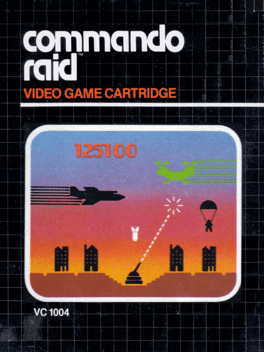
star 5.9You are in defense of your buildings which have come under attack by android commando raiders. Without warning they appear, intent on capturing your buildings and destroying your gun emplacement. First the troop carrying helicopters fly in dropping android paratroopers to test your defenses. Soon the sky is filled with fluttering helicopters and wave after wave of android paratroopers. They must be destroyed! Each paratrooper allowed to land on a building destroys a portion of that building. If three paratroopers land on a building. It will be totally destroyed and must be considered under commando control. Worse still, the androids can now tunnel towards your gun emplacement. Each paratrooper who lands on that building expands the tunnel. If they are not stopped, they will plant an explosive charge under the gun. In the midst of the battle, an aircraft may appear. It will drop a devastating bomb which can destroy all buildings and the gun emplacement. You must shoot it down or at least shoot the bomb it drops.Star Wars: Jedi Arena
1983
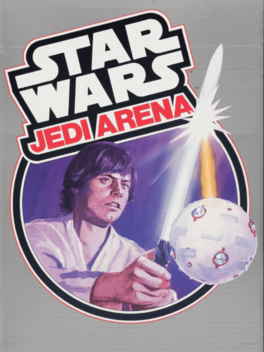
star 5.9In Jedi Arena, you have to face an opponent in the arena to see who is the true Jedi master. Wandering throughout the arena is a seeker which is capable of firing laser bolts. To be victorious you need to destroy your opponents shield by having the seeker fire laser bolts at it. You are armed only with a light saber which is used to control the direction of the laser bolts you fire, as well as block incoming fire from your opponent. The first player to break through the other players shield wins a point, and the first player to 3 points wins the match! Several game options are included which control the speed of the seeker, or even make the seeker invisible.Custer's Revenge
1982
Custer's Revenge
1982
star 3.2You are General Custer. Your dander's up, your pistol's wavin‘. You've set your sights on a ravishing maiden named Revenge: but she's not about to take it lying down, by George! Help is on the way. If you're to get to Revenge you'll have to rise to the challenge, dodge a tribe of flying arrows and protect your flanks against some downright mean and prickly cactus. But if you can stand pat and last post the stings and arrows - you can stand last. Remember! Revenge is sweet. Everytime ol' Custer scores he comes up smilin‘ and right back for more. The higher the score. the more challenging the game action gets.Super Breakout
1981
Super Breakout
1981
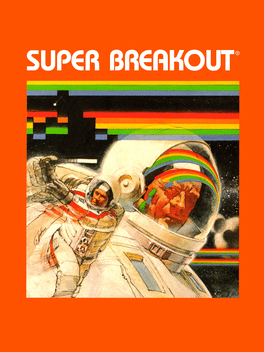
star 6Atari 2600 port of Super Breakout. In Super Breakout, there are three different and more advanced game types from which the player can choose: Double gives the player control of two bats at the same time—one placed above the other—and two balls. Losing a life occurs only when both balls go out of play, and points are doubled while the player is able to juggle both balls without losing either. Cavity retains the single bat and ball of Breakout, but two other balls are enclosed on the other side of the wall, which the player must free before they, too, can be used to destroy additional bricks. Points are increased for this, but triple points are available if the player can keep all three balls in play. Progressive also has the single bat and ball, but as the ball hits the paddle, the entire wall gradually advances downwards step by step, gaining in speed the longer the ball lasts in play.Centipede
1983
Canyon Bomber
1979
Canyon Bomber
1979
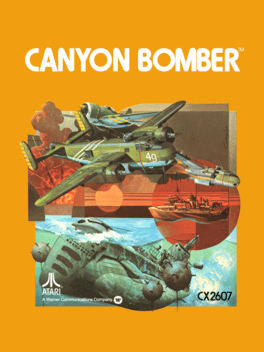
star 3.3Canyon Bomber is the a port of the arcade game of the same name, rewritten in color and with a different visual style for the Atari 2600. The player and an opponent fly a blimp or biplane over a canyon full of numbered, circular rocks, arranged in layers. The player does not control the flight of vehicles, but only presses a button to drop bombs which destroy rocks and give points. Each rock is labeled with the points given for destroying it. As the number of rocks is reduced, it becomes harder to hit them without missing. The third time a player drops a bomb without hitting a rock, the game is over.Tennis
1981
Tennis
1981
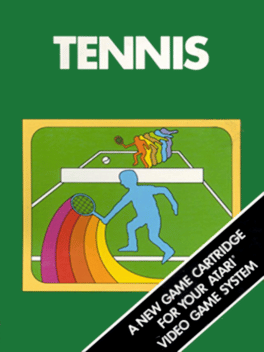
star 4.5Tennis offers singles matches for one or two players; one player is colored pink, the other blue. The game has two user-selectable speed levels. When serving and returning shots, the tennis players automatically swing forehand or backhand as the situation demands, and all shots automatically clear the net and land in bounds. The first player to win one six-game set is declared the winner of the match (if the set ends in a 6-6 tie, the set restarts from 0-0). This differs from professional tennis, in which player must win at least two out of three six-game sets.Ice Hockey
1981
Ice Hockey
1981
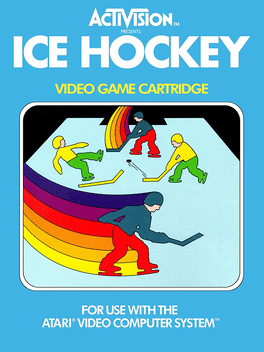
star 4.8Ice Hockey is a game of two-on-two ice hockey. One player on each team is the goalie, and the other plays offensive (although, the goalie is not confined to the goal). As in the real sport, the object of the game is to take control of the puck and shoot it into the opposing goal to score points. When the puck is in player control, it moves left and right along the blade of the hockey stick. The puck can be shot at any of 32 angles, depending on the position of the puck when it's shot. Human players take control of the skater in control of (or closest to) the puck. The puck can be stolen from its holder; shots can also be blocked by the blade of the hockey stick.Skiing
1980
Skiing
1980
star 4.9In Skiing, your goal is to ski to the bottom of the mountain in the shortest time possible. The mountain is treacherous with plenty of trees and moguls in the way! There are two different modes of gameplay. In slalom mode, there are a series of gates you need to ski through; missing any will result in a penalty to your time. In downhill mode you just need to ski to the bottom as fast as possible. Each mode includes five different skill levels which affect the length of the course (and the number of gates in slalom mode.)Video Pinball
1981
Video Pinball
1981
star 4.4Video Pinball is a loose simulation of an arcade pinball machine: ball launcher, flippers, bumpers, and spinners.Laser Blast
1981
Laser Blast
1981
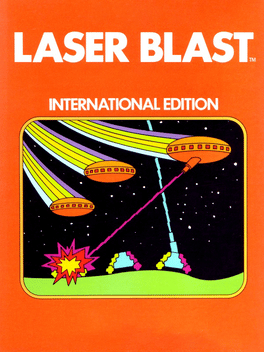
star 5.5The object of Laser Blast is to destroy a series of land-based enemies. The player controls a fleet of flying saucers, operating one at a time. On the planet surface below are a group of three mobile laser bases, guarded by an invisible force field that prevents the player's saucer from getting too close to the surface. Both the player and the enemy bases are armed with laser blasters, which may fire a single continuous beam at a time. If the player's saucer is hit, it will lose altitude and crash to the ground; however, the player may direct this fall, potentially into one of the bases, destroying it as well. Each succeeding wave of enemy bases moves faster and targets the player's saucers more quickly, while the force field becomes stronger and decreases the amount of space in which the saucer can move. Players score points for each base destroyed, with points multiplying each wave up to a maximum of 90 points per base. Players earn extra flying saucers with each 1000 points scored and may keep a maximum of six eStarmaster
1982
Starmaster
1982
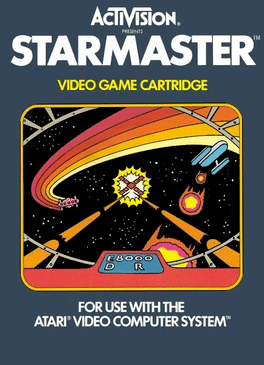
star 2.2In the game the player pilots a starfighter, with the purpose of destroying a number of enemy ships before they destroy four friendly starbases. Gameplay is presented mostly in first person cockpit view, which is achieved with surprisingly good effect given the 2600's primitive graphics capabilities. The starfighter carries laser weapons, shields, and a faster-than-light drive. The fighter also carries a limited energy supply, which is drained by firing the lasers, being hit by enemy fire, warping, or simply flying around. If the ship's energy drops to zero it is destroyed, and the game ends. Enemy fire can knock out the fighter's subsystems (such as weapons) on top of draining energy. The game "universe" is a square-shaped galaxy mapped into a grid of 36 sectors. Each sector can be home to some enemy ships, a starbase, both, or nothing. The player "warps" the fighter to a sector to engage enemy ships; once they are all destroyed, the player moves on to another. The player can also warp to a sector with a starbase,Air Raiders
1982
Air Raiders
1982
star 6.1Air Raiders is an action game released for the Atari 2600 by Mattel in 1982. It received mixed reviews from critics. The player has the view of an airstrip as seen from the cockpit of a jet fighter. In order to start the launch, it is required that the player presses the fire button. When the player pulls back on the joystick, the jet fighter becomes airborne. A feature of the game includes a horizontal tilt that happens when the jet fighter turns to the left or the right for realistic simulation. The goal is to fire at enemy aircraft. The player also has to worry about not making a quick dive after an enemy craft that would lead to a crash landing. There is also a bar that is located on the width of the screen that allows the player to keep track of the horizontal position. It is important to stay out of heavy gunfire zones because it can lead to a nosedive crash. It is possible to pull out of a nosedive, but it would be a better idea for the player to avoid flak.Cosmic Ark
1982
Cosmic Ark
1982
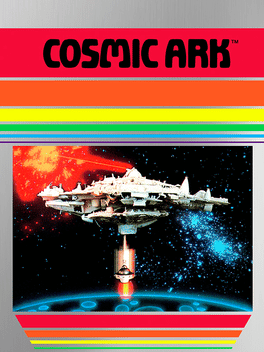
star 6.5The sun of Alpha Ro is fading fast! Soon it will flicker out. The Cosmic Ark races to save creatures from doomed planets in that solar system. Meteor showers bombard the Ark, threatening its Atlantean crew - and planetary defense systems make this mission of mercy doubly treacherous! Time and energy slip away- work fast or these defenceless little beasties will disappear for all time.Frogger
1983
Frogger
1983
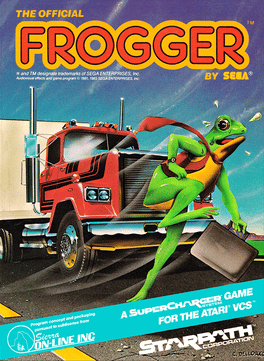
star 5This version of Frogger is different than the Parker Brothers cartridge-based release in 1982. The 1983 Starpath version of Frogger utilized the Starpath Supercharger expansion peripheral created by Starpath for playing cassette-based proprietary games on the Atari 2600. Although Parker Brothers owned exclusive rights to cartridges of Frogger, they did not own the magnetic media rights, opening the door for Starpath to create their own version. The game is one of a few cassette based games ever released for the Starpath Supercharger. Unlike the first two games Landrum designed for Starpath, this one does not contain a secret way to see the designer’s initials.Berzerk
1982
Space Invaders
1980
Space Invaders
1980
star 5.8Space Invaders is a game in which the player controls a laser cannon by moving it horizontally across the bottom of the screen and firing at descending aliens. The aim is to defeat five rows of eleven aliens—some versions feature different numbers—that move horizontally back and forth across the screen as they advance towards the bottom of the screen. The player defeats an alien, and earns points, by shooting it with the laser cannon. As more aliens are defeated, the aliens' movement and the game's music both speed up.Warlords
1981
Dig Dug
1983
Dig Dug
1983
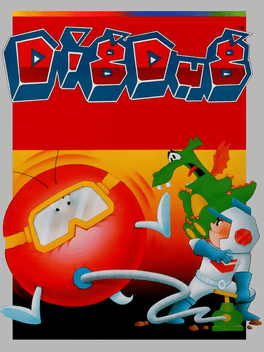
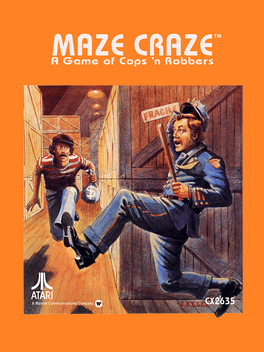
star 6.3Dig Dug is a 1-2 player arcade game in which you have to use your shovel to dig your way through the earth. Stopping you from doing this are two monsters, called Pooka and Fygar, who will continually chase you around. The only weapon that you carry is an air pump, which you can use to inflate the monsters to the point where they explode. (if you start to inflate them but stop doing so, the monsters will get turned back to their normal selves). Furthermore, rocks are scattered throughout the earth, and you can use these rocks to squash them. If the monsters do not find you for several seconds, they will eventually get turned into ghosts, which can walk through the earth. They are invincible and cannot be killed. From time to time, vegetables will appear in the center, and you can get these for points.Maze Craze: A Game of Cops 'n Robbers
1980
star 5.8In Maze Craze, your goal is to be the first of two players to make it out of a maze! Each player controls a cop that starts on the left, and the first player to make it out the exit on the right wins. The game also includes of variety of options. The maze can be completely visible, completely invisible, or have just a few parts invisible. With invisible mazes you can optionally have the computer provide a sneak peak at the complete maze periodically. To make your task more challenging, one to five robbers may also be placed in the maze. If you are caught by one of the robbers, you will momentarily be stunned giving your opponent an advantage. You can also give your cop the ability to set up a blockade to confuse your opponent. This will look like a regular wall, however you can walk straight through it. The games speed can also be adjusted, from calculatingly slow to extremely fast.