Most Popular Atari 2600 Games - Page 10

Heart Like a Wheel
Programmer Jim Collas confirmed that this game was called Heart Like a Wheel and was based on the 1983 movie of the same name. 20th Century Fox had contracted a company called Micro Computer Technologies to create a game to tie in with the movie. Unfortunately the movie didn't do so good and the game was cancelled. Heart Like a Wheel was never completely finished before being cancelled. While the core gameplay is there, the prototype is missing some finishing touches such as correct level progression, the races starting automatically, and more tracks. Although Collas never went on to develop any more VCS games, he had a long and successful career in the computer industry including becoming President of Amiga during Gateway’s ownership of the brand.Secret Agent
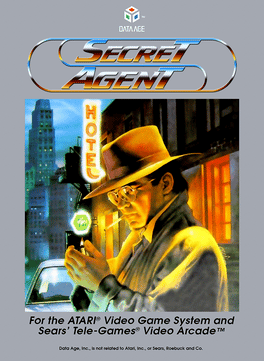
You, the Secret Agent, must catch the falling agent items, like U.S. documents, money cases and money bags, while avoiding the undesirables, like bugs, grenades and guns. After a time, a tone will sound. This is when the boats on the water below you will stop moving and you need to get above them and 'make the hand off'. Be careful, though, for although the boats stopped moving, the falling items have not. In two-player games, the players alternate. Secret Agent was the last Data Age game to be completed, but the crash forced them out of business before it could be released.Shooting Arcade
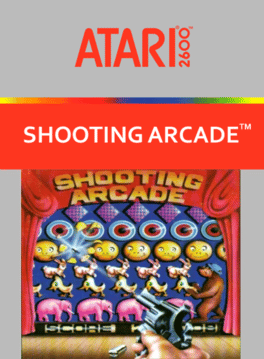
Shooting Arcade is one of only two Atari 2600 games to use the Light Gun (Sentinel being the other), but was never released. Interestingly, it appears that Shooting Arcade was not developed in the US, but rather in Mexico by a company called Heuristica. How Axlon was involved is unknown, but they may have simply sub-contracted the game out to Heuristica instead of doing it themselves. So why wasn't Shooting Arcade released? No one knows the true reason, but one possibility is the flawed targeting system of the Light Gun. Another possibility is the late date of the game (1989). It's doubtful that an Atari 2600 target shooting game would have sold in great numbers, and this is probably why Atari went with the more action oriented light gun game Sentinel instead.SCRMNN
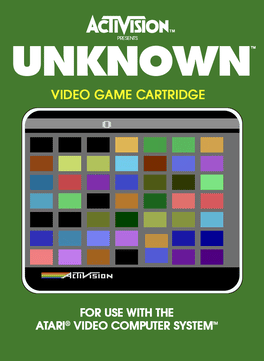
While the prototype was labeled SCRMNN, the actual title of this game is currently unknown (some have speculated that the name on the label might stand for "Screen Manipulation"). Found in a salvage yard in 1998 by Ben Liashenko, the identity of this mysterious Activision prototype has eluded collectors for years. This prototype plays like a cross between a Rubik's Cube and the old sliding tile puzzle game. The goal of the game is to line up all the colors in each row from light to dark. If you've done it correctly the board should look like the start-up screen with the colors descending from red to purple. However lining up all the colors is easier said than done due to the unique way the squares move across the board. When you move your square up or down a row or column, the last square in that row will move behind your square's new position. For instance if your square is the light green one (center of the row), and you move it left it will result in the last square in the row (the light blue one) moving behindRampage
1989
Rampage
1989
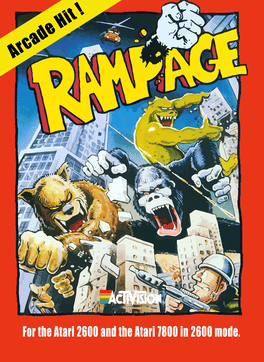
George, Lizzy and Ralph were just ordinary Americans, until an experiment went wrong, turning them into a Gorilla, Lizard and Werewolf respectively. Following this, the three of them plan to go round destroying buildings, and up to 3 human players can join in. Smashing at the edges of the buildings for long enough will make them collapse. The police and military are after you, and will shoot at you, so try to destroy them (failing that, you can avoid the bullets). You will need to eat regularly, with things like plants on offer, to avoid shrinking back to being humanPeek-A-Boo
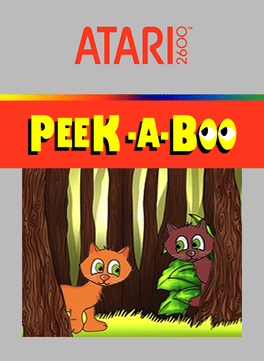
Since Peek-A-Boo was intended for very young children the gameplay is very simple. The main character of this game (a cat named Smart Seymour) moves in and out from behind a square. Depending on the game selected the various elements of the game change slightly. The square may be a single block, a rectangle, or four colored squares. The cat may move far away from the square, or he may barely move half his body out. The cat may move rapidly in and out from behind the square, or he may stay behind the square. There are eight different types of games, each with a slightly different objective.Miss Piggy's Wedding
Miss Piggy's Wedding was a two-player game created in 1983 for the Atari 2600 console. The game was advertised in Atari catalogs, but never made it to final release, due to Atari's cancellation of their Children's series. A prototype of the game was discovered in the late '90s by a private collector. The object of the game was for one player to maneuver Kermit through the church and outside to a waiting taxi, without getting caught by Miss Piggy (controlled by the second player), who insisted that they be married. The obstacles to Kermit were the wedding guests (represented by blocks in the picture), who try to impede his progress through the maze. He also must touch a key in order to open the doors and escape, although if Miss Piggy touches the key, the doors close again. The most complete version currently known for this game was never finished, so the consequences of Kermit escaping or being caught by Miss Piggy are unknown. Additionally, Gonzo appears at the top of the screen as the minister, yet he has no purpMeltdown
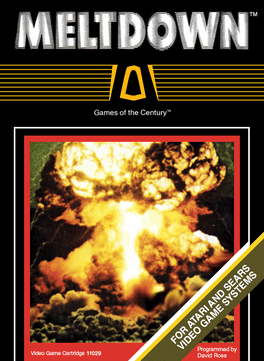
Meltdown is basically a game of hide and seek that place on a 4x4 grid of atoms. At the start of each round you will see a rogue quark move about the reactor agitating the atoms. Each time the quark touches one of atoms it will strip off some of the electrons and atom will shrink. Once an atom has lost all it's electrons it will become unstable, if all the atoms destabilize the reactor will blow! Why 20th Century Fox decided to cancel Meltdown is unknown, but was most likely due to the collapsing video game market. The decision to cancel the game must have been made at the last moment, as advertisements proudly boasting 'Just Released' had already been printed. Although Meltdown was displayed at the 1983 CES show, it was never seen again after the show closed. Long thought lost, Meltdown surfaced in a resale shop in 2004 where by chance it was discovered by a passing collector.Grover's Music Maker
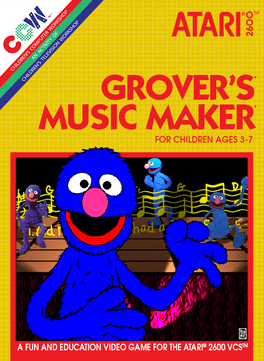
Grover's Music Maker was originally called Monkey Music and featured a dancing monkey instead of Grover. Grover's Music Maker was an attempt by Atari to introduce children to the music through some well known (and some not so well known) children's tunes. Selecting one of the twenty letters (A -T), will cause Grover to start jumping around while some music is played in the background. It's unknown why the game got canned, but it may be due to Atari pulling the plug on the 2600 Children's series after its less than stellar performance. Other reasons may have been poor beta testing results or limited long term playability.Good Luck, Charlie Brown!
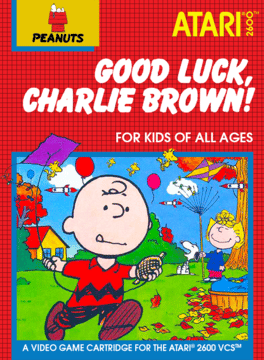
Good Luck, Charlie Brown should have been the last of the Children's Work Shop releases, but never saw the light of day. Although the game was found a long time ago, the rom had not been dumped until quite recently so the game is still a bit of a mystery. The only known version is very incomplete with little gameplay implemented, but rumors persist of a far more complete version in existence. The game only consists of one screen in which you control Charlie Brown as he flies his kite around the screen. At the bottom of the screen there's a wind gauge which shows the speed and direction of the wind. There's also a timer a the bottom of the screen which slowly counts up which may be part of the scoring system (based on total time instead of score). You goal is to fly your kite as long as possible while avoiding birds, balloons, rockets, and of course the deadly Kite Eating Tree. According to the catalog description, if Charlie Brown lost his kite he would have to earn another chance by raking leaves (what fun!). ObviFrisco
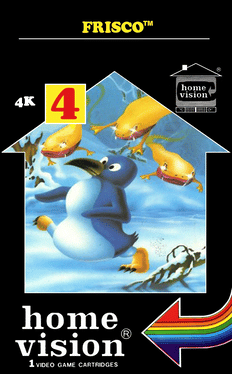
Frisco is an action game, published by Homevision, which was cancelled before it was released.Spinning Fireball
1983
Spinning Fireball
1983
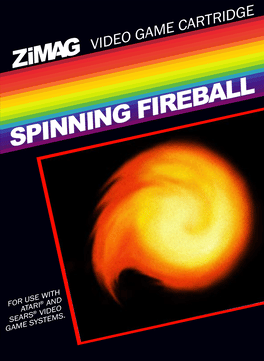
The goal of the game is to have your wizard create and shoot a fireball at the catapult that movies across the top of the screen. The controls for Spinning Fireball are bit difficult to master, which is just as well as you probably won't want to play this game very long. To create your fireball, simply push and hold the joystick forward. Once the fireball starts to spin, press the fire button to shoot it. The direction the fireball flies is based on the direction it was spinning when the button was pressed (sort of like the hammer throw in Track and Field). If you are facing right the fireball will rotate clockwise, otherwise if you left the fireball will rotate counterclockwise. If your shot actually manages to hit the catapult, then you will be taken to the second level. If your fireball hits the sides of the screen it will bounce back at you. Likewise if you shoot your fireball straight up, it will come back down. If you manage to get hit by your wayward fireball, you will lose a life. Also, the catapult at theWalker
1983
Walker
1983
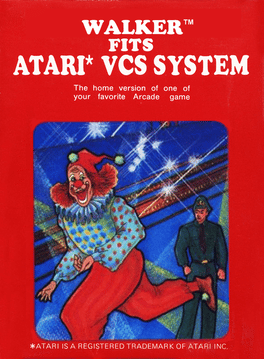
Walker (also known as 'Clown Downtown' or 'Schussel, der Polizistenschreck') is an action game, developed by Starsoft and published by Quelle, which was released in Europe in 1983. The game is similar to another Atari 2600 game: Bobby is going home.Treasure Island
1983
Treasure Island
1983
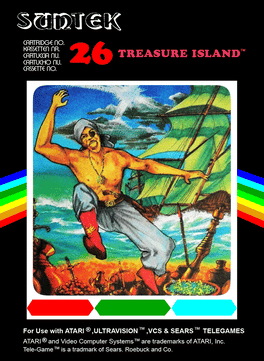
Explore the Island, treasures are hidden there in unbelievable abundance. Your boat trip there is full of dangers: whales and sharks will attack you. The natives are tirelessly bombarding you. And of course rivals have also started looking for the treasures for themselves. You have an unlimited supply of bumps to use against them but only 6 lives to wager!Treasure Below
1983
Treasure Below
1983
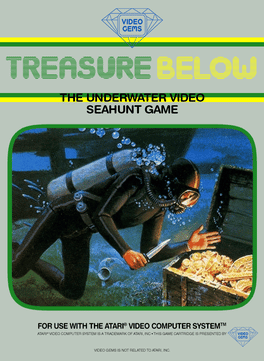
There's fabulous golden treasure down there, just waiting to be taken. There's also much danger with jelly fish, octopus, sharks and other undersea creatures patrolling the deep. You've got your trusty knife and speargun for protection. Be careful, sometimes these sea monsters will surround you and you have to fight your way to the top to keep your golden treasure along with your quest. The action gets faster and faster. You test every video skill you know, plus invent a few new ones, but get that treasure you will.Turbo
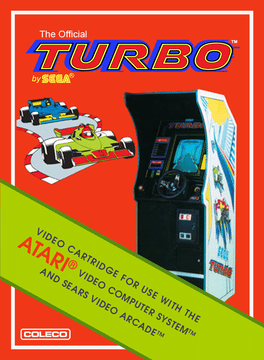
Based on the 1981 Sega coin-op of the same name, Turbo is one of those prototypes that everyone was sure existed somewhere (it was shown at the 1983 CES once), but never seemed to show up. Thankfully all this changed when former Atari 2600 programmer Anthony Henderson happened to stumble across his long lost copy of Turbo while searching his attic. According the programmer, Coleco originally wanted the game to use paddle controllers in order to better simulate a steering wheel. However reading the input from paddle controllers takes up considerably more clock cycles than reading regular joysticks, and there was not enough time to animate the road edges. After pleading with Coleco, they were allowed switch the game from using paddles to joysticks, which freed up enough time to insert the road edge movement but the game was cancelled before it was actually implemented. Other missing features include the ambulance, water puddles, and the enemy car AI (although implemented in the current prototype, it was never tweakedMazy Match
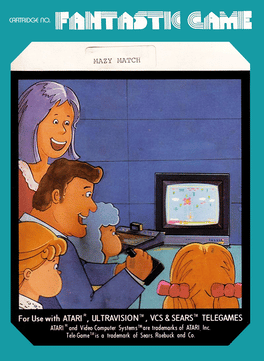
Try to reach the symbols at the top of the screen before you run out of energy by walking an invisible path on a randomly generated grid while avoiding UFO's and rocks dropped by birds. You can choose a new path at the bottom of the screen. Reaching a Minus: You loose 300 points. Return to the beginning of your chosen path to get new energy. Reaching a Plus: You gain 1000 points. Return to the beginning of your chosen path to get new energy. The flashing UFO's can be destroyed (500 points) by touching them. Reaching a Sword: You gain 500 points. The grid becomes invisible and all paths are walkable now. Return to the bottom of the screen to get new energy. The flashing UFO's can be destroyed (500 points) by touching them. When you get hit by a non-flashing UFO, you will loose 1 life. When you run out of energy, you will loose 1 life. Sometimes the paths change position and you will fall off and loose 1 life. Sometimes you can teleport from one vertical path to another. The game has a 2 player mode and 8 difficultyMcDonald's: Golden Arches Adventure
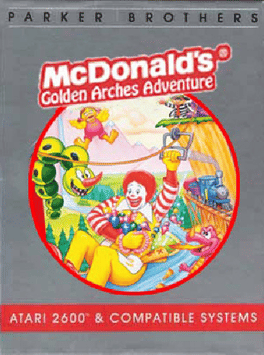
The existing prototype uses the Tutankham game code. As such, PARKERBROS 83DAVEENGMAN can be found at the very end of the compiled code listing, along with a few of the Tutankham explorer graphics. Also, the characters 0123456789, ABCDEFTWV, and PLAY are in the code. Although McDonald's is far from finished, the game's designer Isabel Garret was able to give us the details on how the game would have been played: 'You are Ronald McDonald flying in your spaceship. Hungry aliens are descending on the Golden Arches below to eat them. You must fly down to the ground and pick up McDonald's food to bring up and feed the aliens, but certain aliens will only eat certain McDonald's fast food (shakes, fries, hamburgers) so you need to feed them the right food. If you don't feed them in time, they start to eat the Golden Arches, but not to worry, you can fly back down to the ground and pick up pieces to rebuild the Golden Arches'.Gauntlet
1983
Gauntlet
1983
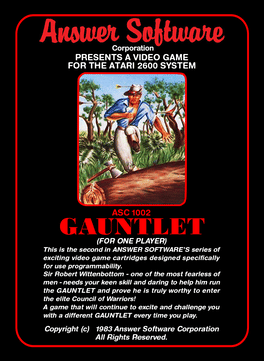
This game has nothing to do with the Atari arcade game or any of the home-ported versions. You are the great explorer, Sir Robert Wittenbottom. You have discovered an ancient civilization deep within the forest of a mysterious island. Since you're a likable old fellow, they have decided to induct you into their council of warriors. But first you must prove your worthiness by running the gauntlet. You are given three glasses of water. You must run through the gauntlet to the ceremonial fires and use your water to put them out. You current glass of water will then be refilled then it is off to the next fire. Of course, it is not that easy. You must jump over rocks and logs, duck under stones, arrows and tomahawks, and avoid hitting trees or touching the sides of the gauntlet.You can ease the thirst of the old men you come across for points but it will cost you water. The game is over when you run out of your third glass of water. To jump, just press the fire button. To duck, pull back then press the fire button.My Golf
1990
My Golf
1990
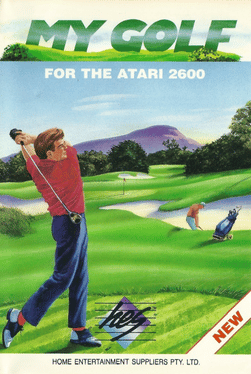
Welcome to MY GOLF! The latest state-of-the-art golf simulation for your ATARI 2600. It's amazingly real with rivers, sand traps, ponds, trees, roughs and out of bounds. Play alone or join a friend into a relaxing game of MY GOLF. But don't be fooled, you need skill, strategy and great concentration.