New Games - Page 13065

The Blue Marlin
1991
The Blue Marlin
1991
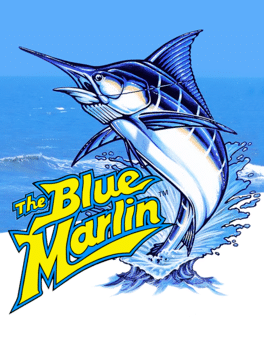
The Blue Marlin was developed by Hot B in 1991 for the Nintendo Entertainment System. Following their earlier release The Black Bass, Hot B built on some of the original features for this fishing game. With the abilty to gradually increase attributes in muscle power, body strength, and skill; the player has more control over how the game is played compared to Black Bass.Dragon Saber
1991
Dragon Saber
1991
Dragon Saber is a vertical scrolling shooter arcade game, released by Namco in 1990; it runs on Namco System 2 hardware, and as its complete title suggests, it is the sequel to Dragon Spirit which had been released three years earlier. The sequel to Dragon Spirit follows much in the same vein, with your flying dragon defeating prehistoric monsters over various landscapes. This time round there is a two player mode thrown in for extra appeal.Momotaro Densetsu Gaiden
1991
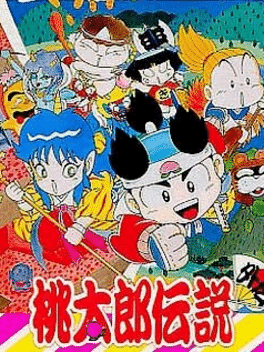
A spin-off of Hudson's Peach Boy RPG series that focuses on three side characters instead. Momotarou Densetsu Gaiden ("Peach Boy Legend Side-Story"), known as Momotarou Densetsu Gaiden: Dai 1-Shu ("Peach Boy Legend Side-Story: Volume 1") for PC Engine, is a non-core entry in Hudson's Momotarou Densetsu series of RPGs loosely inspired by the titular folklore figure. It was first released on the Game Boy in 1991, and then ported to the PC Engine the next year and the Famicom the year following that. The game switches focus from Momotarou to three extra characters, each has their own distinct campaign to play through. One follows a standard RPG route of a hero's journey, another involves the princess of the kingdom of demons as she attempts to uncover an attack on her father's throne with a band of allied monsters, and the third involves a thief who steals money from monsters and gives it to beggars. Each campaign follows the core gameplay of the series: overworld exploration and turn-based combat.Wacky Races
1991
Wacky Races
1991
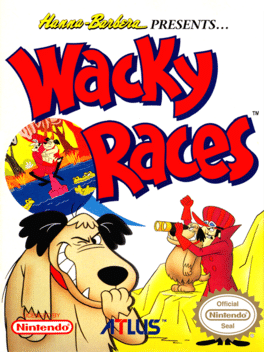
star 6.2Wacky Races is a platform game for the Nintendo Entertainment System, developed and published by Atlus. The game is based on the Hanna-Barbera cartoon Wacky Races and features Muttley and Dick Dastardly as the main characters. An unrelated Amiga and Atari ST game of the same name was released in 1991 and a racing game of the same name came out in 2000.Who Framed Roger Rabbit
1991
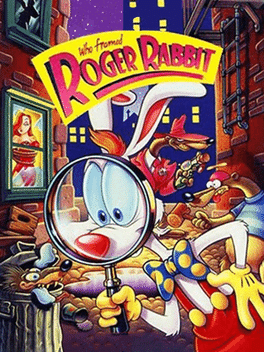
Roger is summoned by Marvin to his factory to take his deed and get his will from Jessica Rabbit to save Toontown from the greedy Judge Doom. Immediately after, Marvin is sniped through his office window and killed. As Roger meets Jessica she is kidnapped by both Doom's weasel henchmen. Roger gets help from Eddie Valiant. Through his investigation Roger faces Stupid, Greasy, Psycho, and Smarty weasels and finally makes it to Doom's mansion. He makes it past the complex and confront Doom, defeating him and destroying his Dip Machine.Ganbare Goemon: Sarawareta Ebisumaru!
1991
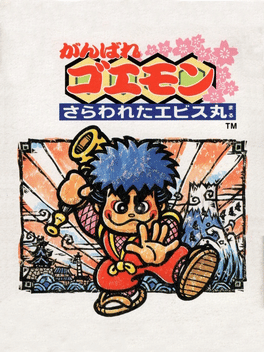
Originally released as Ganbare Goemon: Sarawareta Ebisumaru!, it is a Game Boy game released in 1991 and the first game in the Goemon series ever released for a portable system. Gameplay is similar to Ganbare Goemon! Karakuri Douchuu which was released on the Famicom. Only Goemon is playable, and the game consists of him rescuing Ebisumaru; Sasuke and Yae do not make appearances.F1 Exhaust Note
1991
F1 Exhaust Note
1991
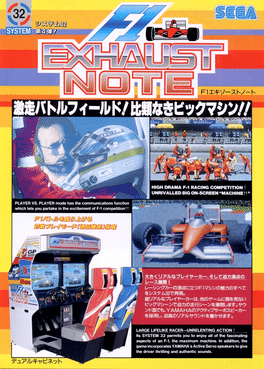
F1 Exhaust Note is a two-player arcade game modeled on Formula One racing game, released in 1991.Minna no Tabou no Nakayoshi Daisakusen
1991
Minna no Tabou no Nakayoshi Daisakusen is a Puzzle game, developed by Bits Laboratory and published by Character Soft, which was released in Japan in 1991.SD Gundam Gaiden: Knight Gundam Monogatari - Ooinaru Isan
1991
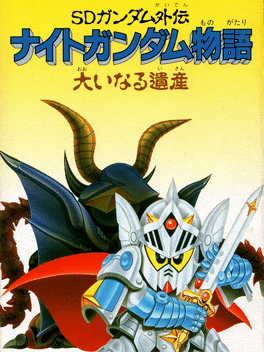
Role-Playing video game released by Angel in 1991 for the Super Famicom. It is based in the SD Gundam universe, a spin-off of the popular mecha anime franchise.Best Keiba Derby Stallion
1991
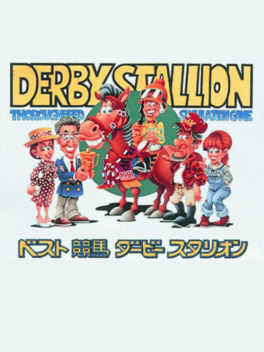
Best Keiba Derby Stallion ("Best Race Derby Stallion") is a simulation game where the player has a stable and starting money and must raise champion racehorses. As well as training horses, they can breed them and, eventually, sell them once they grow too old to race. The player can also hire jockeys to ride their horses for races, and can gamble on races to earn a little extra funds. Best Keiba Derby Stallion began a long-running Derby Stallion franchise that persists to the present. It was only released in Japan.Choujin Sentai Jetman
1991
star 7.9In the year 199X, Earth Defense Sky Force orbits the planet. They survey the Earth 24 hours a day to maintain world peace. When problems arise they send in agents to help out. SF-W6 and SF-W3 are two such agents. Upon completing a mission they are promoted to J-project status. Aboard the ship, The Chief explains that when hit with Birdronic waves, they will turn into Choujin Sentai. Immediately after Tendou Ryu's conversion into a Jetman, the enemy Vyram attack. Radiguet, the leader of the Vyram, announces that they have conquered other detentions and now plan to conquer the 3rd dimension. During this attack, Ryu loses his girlfriend Rie through a hole in the ship. The Birdronic wave machine shatters and the remaining 4 waves are sent down to Earth at random. After the attack Ryu and The Chief search the Earth to find the remaining members of the group.Battle Storm
1991
Battle Storm
1991
The game allows players to do combat strategies with tanks, airplanes, military bases, and non-nuclear missiles. These advanced weapons allow players to stage a fictional World War III and to simulate modern warfare. Players can assume the persona of various clichéd Hollywood action film stars like Rambo, Chuck Norris, Eddie Murphy, Bruce Lee, and Arnold Schwarzenegger. Stages include a jungle, forest, the swamp, and urban terrain. The player must choose a tank with his or her directional pad. Once there, the player must decide either to move a unit or destroy the enemy on sight. Destroyed units can be rebuilt for money and the first person to run out of cash loses the war. Both players can enjoying the fun and games with more $250 million of virtual game currency to spend on cool military toys to fire at each other.Fantasia
1991
Fantasia
1991
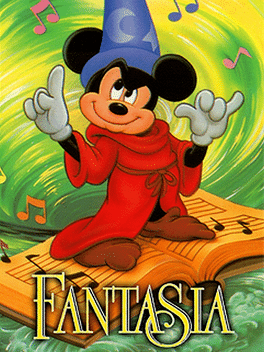
star 5.8In the single-player game, the player controls Mickey Mouse as the Sorcerer's Apprentice through various side-scrolling levels in an attempt to collect musical notes that somehow went missing whilst he was asleep. Each of the four levels were based on amalgamations of the segments of Fantasia, each one around the elements: water (The Sorcerer's Apprentice, Dance of the Reed Flutes and Arabian Dance), earth (The Rite of Spring), air (Russian Dance, Pastoral Symphony and Dance of the Hours) and fire (Night on Bald Mountain, Toccata and Fugue in D Minor). The player defeats various enemies by jumping on them or by collecting magical bubbles that could be used to shoot at enemies as projectiles. In each level, the player collects a certain number of hidden magical notes in order for the song to play once again.Lord of Darkness
1991
Lord of Darkness
1991
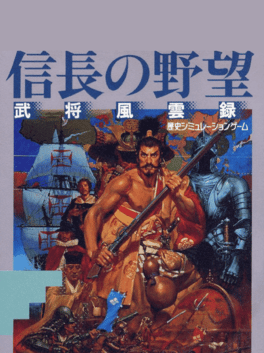
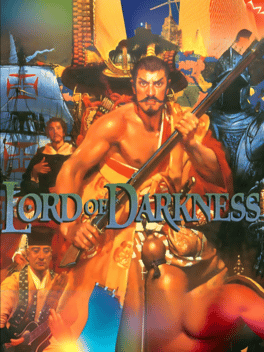
Nobunaga's Ambition: Lord of Darkness is the fourth game in the Nobunaga series (but only the third one to have been localized in English). The story of Nobunaga takes place during the Japanese civil war of the 16th century. In a wartime strategy game, 15 different warlords are represented across several territories. One to eight human players can play, controlling different leaders and factions. Gameplay is done in one of two scenarios; the beginning of the civil war in 1555 or Nobunaga surrounded by his enemies in 1571. Management of population, supplies and military are the gameplay and successful manipulation of these numbers in the right combination to attack and defend against hostile intentions is what will bring your forces to victory.Operation Europe: Path to Victory 1939-45
1991
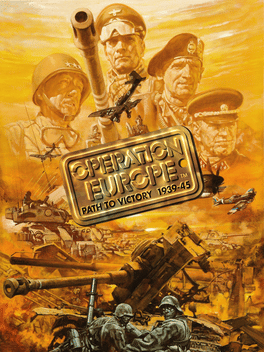
PC-9800 Series Sharp X68000 PC-8800 Series Super Nintendo Entertainment System Sega Mega Drive/Genesis DOS FM Towns MSXThe game is an historical simulation of the European and North African theaters of World War II. The game allows up to two players to role-play as Army commanders for either the Axis or Allied forces. This game emphasizes the military aspects of the war and leaves diplomacy to the politicians.Popful Mail
1991
Popful Mail
1991
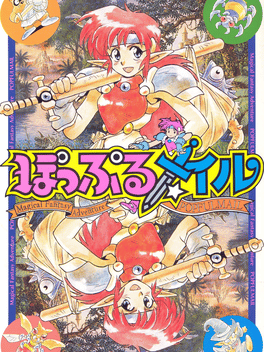
Mail is a young, cute, enthusiastic female bounty-hunting elf. Unfortunately, every time a bounty is near, something goes wrong: the last case was particularly painful, involving Mail bravely cutting off the head of a famous criminal - only to realize that his body escaped without the head. Mail tried at least to sell the head in the nearest town, but discovered that the local tavern was full of these heads stored in a basket. But not all is lost: Mail reads a poster that promises a big reward for someone who catches an evil wizard who terrorizes the land. Sounds like just the job Mail was looking for!