Most Popular Arcade Games - Page 121

Block Hole
1989
Block Hole
1989
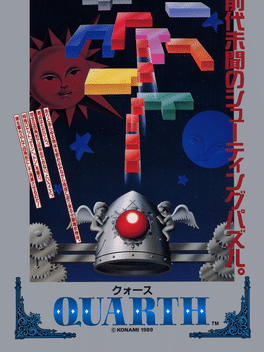
Block Hole is a combination of Tetris-style gameplay and a fixed shooter in the Space Invaders tradition. The player's focus is on falling blocks, and the action is geometrical. Rather than arranging the blocks together to make a row of disappearing blocks, a spaceship positioned at the bottom of the screen shoots blocks upwards to make the falling block pattern into squares or rectangles. Once the blocks have been arranged properly, the shape is destroyed and the player is awarded points based on the shape's size. The blocks continue to drop from the top of the screen in various incomplete shapes. As each level progresses, the blocks drop at greater speed and frequency. There are also various power-ups which could be located to increase your ship's speed, among other bonuses. The game continues until the blocks reach the dotted line at the bottom of the screen, whereupon the player's ship is "quarthed," crushed flat.Battle Lane Vol. 5
1986
Battle Lane Vol. 5
1986
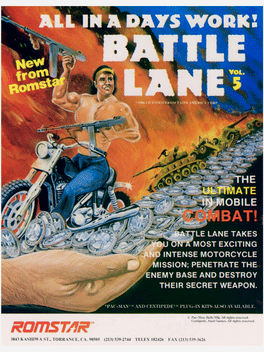
The fate of the country hangs in the balance. Break through the enemy checkpoints using your machine gun, bazooka and driving skill. Pick up more bazookas five missiles each along the road. Finally, enter the enemy base and destroy their secret weapon. The game has five checkpoints with the base coming after the fifth checkpoint. Each wall is broken with five missiles. Hint: shoot seven to ten defenders before trying for the wall.Bogey Manor
1985
Bogey Manor
1985
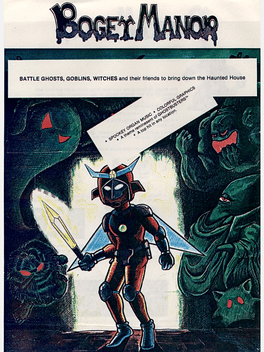
You play as a young ghost hunter boy who runs around a haunted house. Your objective is to destroy with your sword all the crystal balls that are in the house, you must go through all the floors and go through the doors guided by the map at the top of the screen in a time limit without getting caught by the ghosts, frankenstein, witches and other creepy creatures. With the help of your magic glove can freeze ghosts for a short period of time to later hit them with the sword. Once you've destroyed all the crystal balls, the haunted house starts falling apart, and you must run for your life towards the exit to win the stage. You can transform into a super hero, entering through the flashing door to grab special items.Boulder Dash Part 2
1990
Boulder Dash Part 2
1990
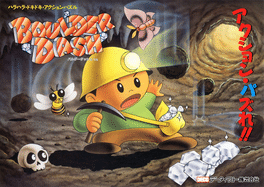
The game's protagonist is called "Rockford". He must dig through caves collecting gems and diamonds and reach the exit within a time limit, while avoiding various types of dangerous creatures as well as obstacles like falling rocks and the constant danger of being crushed or trapped by an avalanche, or killed by an underground explosion.Cheeky Mouse
1980
Cheeky Mouse
1980
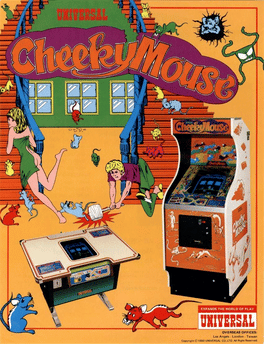
Try to hit the mouse with a hammer when it comes out from one of the holes in the wall. The mouse will try to get from its hole to the cheese on the other side of the house.Chicken Shift
1984
Chicken Shift
1984
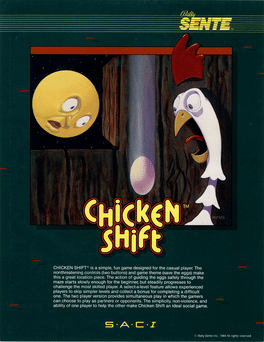
The gameplay in Chicken Shift is relatively simple. There will be a string of eggs you have to guide to safety by shifting the position of pipes, walls and other devices through button presses. The default settings map the action buttons to the left CTRL and left ALT keys. Keep your eyes on those eggs and where they're at - you'll get bonus points if you don't lose a single egg to the horrors of gravity.Cosmic Alien
1980
Cosmic Alien
1980
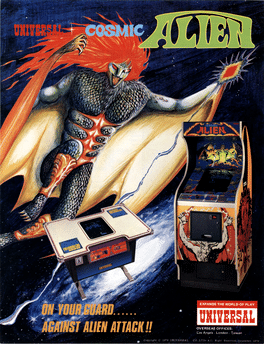
Cosmic Alien is an arcade game that is a clone of Galaxian. Players control a gun at the bottom of the screen that shoots at aliens (which are known as "chiefs", "guards", "commanders", or "soldiers") that are in a formation overhead. Aliens begin peeling off the formation and fly towards the bottom of the screen while dropping bombs. There are two flagship-type aliens (chiefs) at the top of the screen that can fly accompanied with one or more escort (guard) aliens; shooting one or more of the guards before shooting a chief will increase the amount of the chief’s score. If a player does not shoot an alien (or if it doesn’t ram the player’s gun) during its attack run it will return to the formation. There are a few differences with Galaxian, as sometimes aliens will return to the formation without dropping below the bottom of the screen (and then reappearing at the top). They also can shoot off a wide horizontal string of bombs, rather than individual shots like on Galaxian. If the last alien on a level (knowGalivan - Cosmo Police
1985
'Cosmo Police Galivan' is an action game that was released from Nichibutsu in 1985. Players are transformed into 'Galivan' with putting in hand the power crystal, to destroy the universe criminal organization 'Aku'.Senjyo
1983
Senjyo
1983
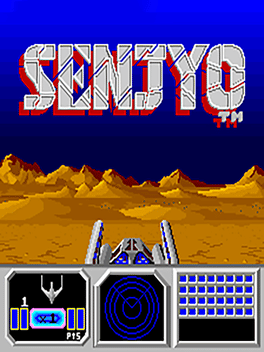
The title of this game translates from Japanese as 'Battlefield'. The simple gameplay involves the player controlling a fixed turret on a tank shooting oncoming alien enemies through a cross-hair target. A certain number of enemies must be destroyed to progress to the next stage. The original arcade cabinet was a cocktail table.Ark Area
1987
Armored Car
1981
Armored Car
1981
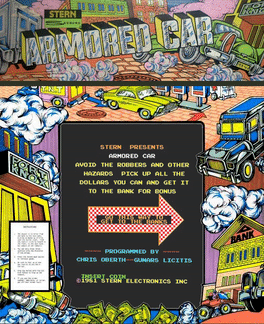
You drive a money van (the armoured car) through as it scrolls from right to left. Some intersections are marked with directions. You pick up money to deliver to banks while avoiding criminals by dropping saw horses on the road. Fuel levels must be replenished at gas stations along the way.Atari Soccer
1980
Atari Soccer
1980
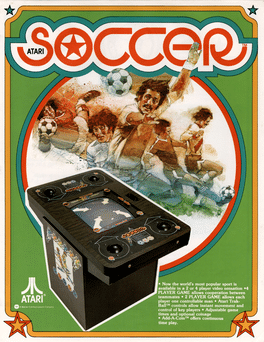
Atari Soccer is, as the naming implies, a soccer arcade game that was released by Atari in 1980; it utilizes a Motorola M6502 (running at 750 KHz), and the players must use a trackball to take control of a player (two on each team, and if there are only two players, the CPU shall fill in for 3P and 4P), with two buttons for kicking the ball with their left and right feet. The human-controlled players will be indicated by the "squares" (1P and 3P) and "crosses" (2P and 4P) upon their heads - and just like in real association football, whoever has the most goals when the timer has run out wins the game. 1P and 2P's team is black, and 3P and 4P's team is white; and as with the four-player version of Atari's earlier American football game, one credit buys a two-player game and two buy a four-player game.Baluba-louk no Densetsu
1986
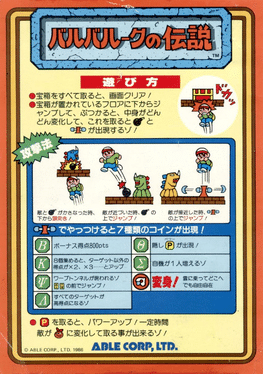
Baluba-louk No Densetsu is a platform arcade game released by Able in 1986. An explorer must get all the treasure chests while avoiding the monsters.UniWar S
1980
UniWar S
1980
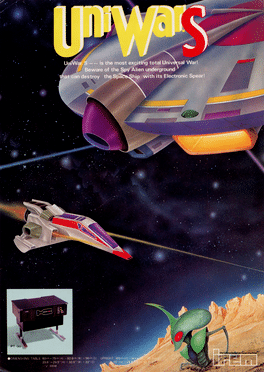
Gingateikoku no Gyakushū (銀河帝国の逆襲), released as UniWar S in the United States is a fixed shooter arcade game that was released by Irem in 1980; it runs upon Namco's Galaxian hardware (a Zilog Z80 running at 3.072 MHz). The player must use the two-way joystick to direct a yellow ship left and right (across the bottom of the screen), with a single button to make it fire shots up at the various types of enemies - and the first stage will see it fighting a formation of "Super Mosquitoes", which are worth 20 points apiece. The second stage, which sees a dotted orange line under the ship, will see it fighting a formation of "Hovering Attackers" which are worth 30 points apiece, and the third stage will see it fighting a formation of "Demon Flies", which are worth 40; some of the "Demon Flies" will leave "Spy Aliens" when killed, which will fall down to the bottom of the screen underneath that line, and try to stab the ship from behind. The only way to kill them (for 100 points apiece), is to destroy the "KIntruder
1979
Intruder
1979
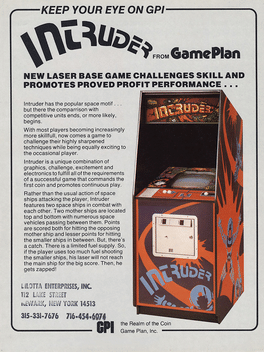
Intruder is an arcade game originally released by Konami as Space War. It is a one-on-one spaceship combat game with each player controlling a ship at the top or bottom of the screen. Between the players is a stream of innocent space ship traffic limiting the possibility of getting a clean shot. When your fuel reaches a high number (like 75 or so) your laser will reach the other side of the screen to get your opponent. Once you fire your laser your fuel drops sharply and you must wait for it to build before you can shoot at your opponent again. Space War is Konami's first known original video game design. It was licensed by Taito, who released it as Space Laser (in Europe), and by Game Plan, who released it as Intruder (in North America).Pleiads
1981
Pleiads
1981
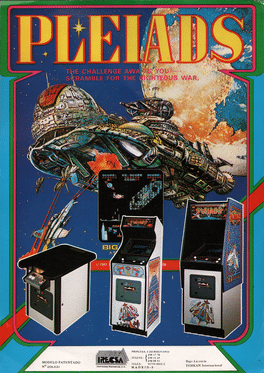
Pleiads is a multi-stage space shoot 'em up in which enemy ships fly at the player in waves in a similar fashion to games like Galaxian and Phoenix. Ships emerge from a mothership at the top of the screen and swoop downwards in a series of patterns which players must anticipate as they shoot the ships and avoid being obliterated by the Martian onslaught. There are four stages in the game. In the first stage the Earth space ship must defend the space station from Martian invaders who have the ability to transform from flying invaders, to walking invaders who build walls across the Earth city; these barriers must be destroyed. At the end of stage one the Earth space ship flies to the top of the screen to prepare to meet stage two. In the second stage the player encounters eight space monsters who must be hit directly on center to be destroyed before moving onto stage three. In this stage invaders emerge form a space ship at the top of the screen and swoop down on the player in sweeping attacks. In the final wave theTime Pilot 84
1984
Time Pilot 84
1984
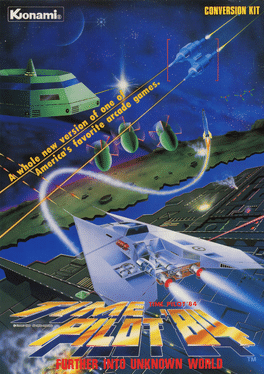
Time Pilot '84: Further Into Unknown World is an eight-way scrolling shoot 'em up, released in 1984 by Konami. It is the sequel to Time Pilot. The player pilots a craft over many time periods. Unlike the original which told the year of each level, the new time periods are designated by new enemies and different colors. There are a large number of enemy types in the game. They each have varying movement patterns, difficulty, and point values. The first button is used to fire a standard shot, which can destroy green-colored enemies. The second button is used to fire missiles, which can destroy the silver-colored enemies. You need to lock on to a silver enemy to fire missiles at it. Destroying enough green enemies brings out a large silver "boss" enemy that must be dispatched before advancing to the next level.Mega Zone
1983
Mega Zone
1983
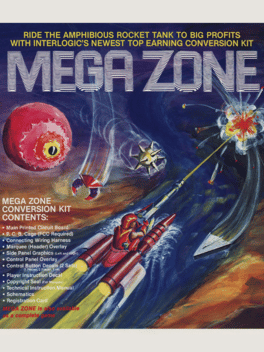
This game has flavors of several different video games rolled into one. It is mostly like Xevious, being an overhead shooter against a plethora of enemies, each with a unique characteristic. Unlike Xevious, however, that only allowed you to travel in one straight path, Mega Zone periodically allows you to choose different paths. For most of the game, the player's ship flies along a river. When the river forks, the player has the option of following either fork. The game also has elements of Scramble, in that the player fights through numerous zones in the struggle to reach the end. Where Scramble has a progress bar at the top, Mega Zone gives the player a map, and shows the player the progress along the map between lives. The main enemies of Mega Zone are giant robot eyeballs. Easily enough destroyed, they still pose a menace. Smaller eyeballs leave teardrops when destroyed, which when picked up, give bonus points and wipe out all enemies on the screen.The Glob
1983
Terra Force
1987