Most Popular Arcade Games - Page 10

D1 Grand Prix
2008
D1 Grand Prix
2008
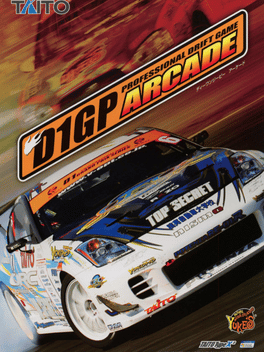
star 6D1GP Arcade (2008) is a specialized drift racing simulation developed by Yuke's and Taito that focuses on scoring high points through technique rather than speedArcana Heart
2006
Arcana Heart
2006
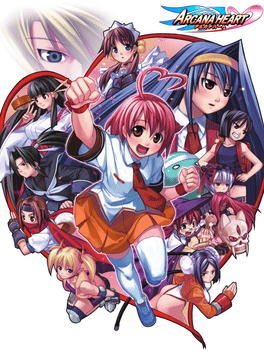
star 7A 2D fighter bursting with brawling anime-style beauties, for the PlayStation 2 computer entertainment system. These gorgeous fighters will make your jaw drop with their looks (or their fists).Chequered Flag
1988
Chequered Flag
1988
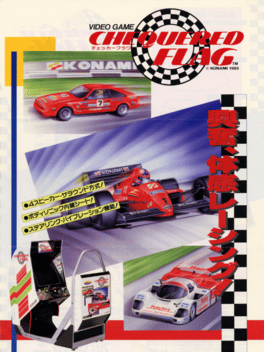
star 6An overhead-view racing game featuring rotational sprite scaling. The player races over a series of twisting courses, trying to reach the finish line before the timer expires. Chequered Flag includes a Pit-stop facility, a feature that had appeared a year earlier in Taito's 'Continental Circus'. Should the player's car sustain too much damage, a pit-stop must be made to implement repairs. A 'damage meter' at the bottom of the screen shows the severity of the damage; highlighting what car components are in need of repair; Engine, Front Tires, Rear Tires and Brakes.Samurai Shodown: Edge of Destiny
2008
star 4.5Samurai Shodown: Edge of Destiny follows a young European girl named Suzu, rescued from a sinking ship off Japan's coast, adopted by the Amori Clan and raised as Princess Suzu. A decade later she saves Takechiyo, a self-proclaimed master of martial arts, after his ship sinks and he ends up washed on the beach; soon after this chance meeting, the tables turn when Princess Suzu mysteriously disappears and Takechiyo pledges to find his missing rescuer.Sonic Blast Heroes
2011
Chunithm Mate
2026
Chunithm Mate
2026
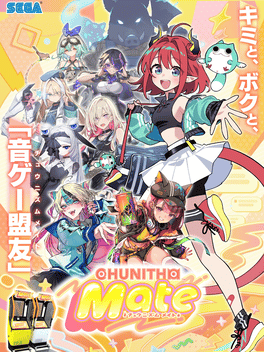
Chunithm Mate is a rhythm arcade game focused on hitting notes in time with the music. Players interact through fast, continuous note patterns that test timing, accuracy, and reaction as songs increase in complexity.Round Up 5: Super Delta Force
1989
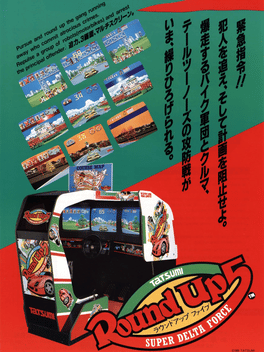
Round Up 5: Super Delta Force is a clone of Chase HQ, featuring flat-shaded cars and a goofy depiction of various American cities. Each boss car now comes surrounded by armed motorcyclists that must be defeated.Quake: Arcade Tournament Edition
1998
The classic PC shooting game has been adapted for tournament play in the arcade. This prototype features modified deathmatch levels and a special custom weapon. Machines may be linked to provide competitive play.Eyes
1982
Eyes
1982
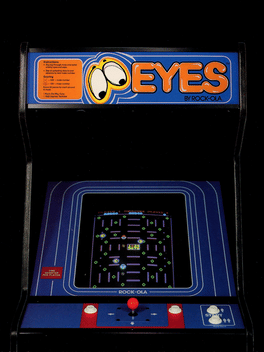
The player controls an eyeball in a maze. As in Pac-Man the goal is to collect all of the dots to advance to next level, but in Eyes the player shoots the dots rather than eating them. Computer-controlled eyes chase and shoot at the player. Shooting a computer eye gives points and removes it from the level, but it will reappear a short time later. Being shot by a computer eye is fatal.Match It
1987
Chaos Code Nemesis Experiment
A brand new fighting game for arcades, " Chaos Code Nemesis Experiment ," is coming to arcades nationwide from FK Digital and exA-Arcadia! This title is the latest installment in the popular fighting game series "Chaos Code." With widescreen support, battles are more dynamic and fast-paced, and the series' signature systems such as "Skill Select" and "Dash Select" remain intact. Even with the same character, different fighting styles are possible depending on the selection, allowing for a wider variety of tactics. Furthermore, a new gauge system, "NEX Gauge," has been introduced in this game, further deepening the strategic depth. And of course, the series' other charm, the unique characters, are also present. Many unique members will be joining the fight, including the otaku protagonist "Hikaru," the chef "Bravo" who engages in cooking battles, and the cosplay-loving shojo manga artist "Catherine." In addition, a new character, the middle-aged transforming hero "Gou," will appear! With a comical yet passionate batNeo Turf Masters Scotland
2026
A transplant of the Scotland course from the Neo Geo CD version of Neo Turf Masters into the MVS (arcade) / AES (home console) version of the game. This work takes the original MVS/AES ROM set and replaces the old Australia course with the Scotland course from the Neo Geo CD version of the game. This includes the Scotland-specific gameplay graphics and hole maps, the cinema and scoreboard backgrounds, and the sound clips played on course selection. Finally, anyone who can play MVS/AES games can play Neo Turf Masters’ most challenging course, and without burdensome load times.Sky Alert
1992
Sky Alert
1992
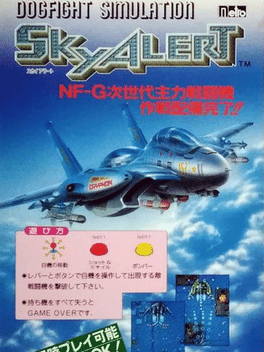
Sky Alert is a vertically scrolling shoot-'em-up. There are two planes to choose from: Type A and Type B. Both have two primary weapons which can be changed during the game as well as one bomb attack. Type A plane has a laser supported by short range napalm bombs and a wide range attack with homing rockets, while Type B has a spread vulcan cannon accompanied by missiles and a powerful autocannon with spread missiles.F-1
1976
F-1
1976
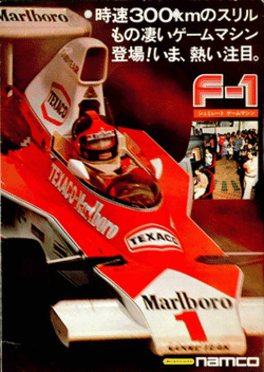
F-1 is a 1976 electro-mechanical arcade racing game developed and published by Nakamura Manufacturing Company (Namco), and distributed in North America by Atari, Inc. The player uses a steering wheel to control a Formula One racer, which must avoid collision with other vehicles. The game uses a miniature diorama with small, plastic cars to represent the player's car and opponents on a physical, rotating track, while also featuring a projector system and lighting tricks to create the illusion of racing.Hot Pinball
1995
Hot Pinball
1995
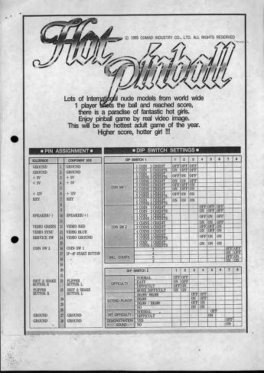
Hot Pinball is an Adult Video Pinball game released in 1995 by Comad/New Systems Japan. It has four boards.Mahjong Sisters
1986
Mahjong Sisters
1986
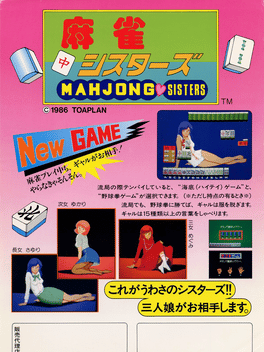
Mahjong Sisters is a 1986 eroge mahjong arcade video game developed and published exclusively in Japan by Toaplan. In the game, the players face off against a group of three sisters in a series of mahjong matches. As of 2019, the rights to the title is owned by Tatsujin, a company founded in 2017 by former Toaplan member Masahiro Yuge and now-affiliate of Japanese arcade manufacturer exA-Arcadia alongside many other Toaplan IPs.Wartracks
2001