New Arcade Games - Page 145

Trivia
1975
Trivia
1975
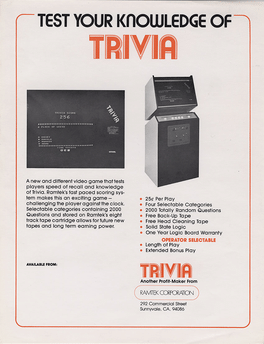
Released in November 1975, Trivia was the first trivia game in arcades. The 2000 trivia questions were stored on a 8-track tape cartridge.Jet Fighter
1975
Jet Fighter
1975
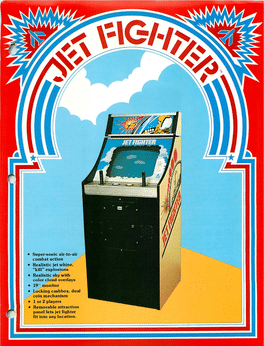
The game is housed in a custom cabinet that includes two 8-way joysticks (one per player) meant to look like older style flight sticks. Each stick has a fire button mounted on the top. The players fly in simulated jets around the screen, engaging in a dogfight and attempting to score hits on their opponent within a limited amount of time. When a player is hit, their plane spins around and an explosion is heard. After a few seconds, the plane recovers, pointing at a random direction.Crash 'N Score
1975
Crash 'N Score
1975
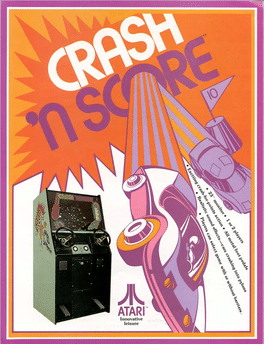
Crash 'N Score is a 2 player arcade game by Atari Inc., originally released in 1975. Gameplay is a simulation of a demolition derby, in which players compete by smashing each other and running over randomly appearing numbered flags within an allotted time. Players can choose to play with or without barriers.Steeplechase
1975
Steeplechase
1975
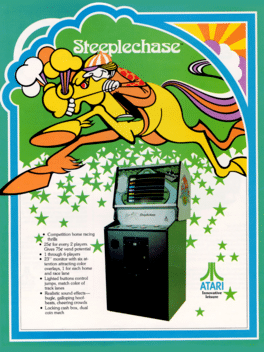
Steeplechase is a 6-player arcade game by Atari Inc., originally released in 1975 and simulating a steeplechase-style horse race. Up to six players can play against each other, each choosing a horse while the computer controls the seventh horse on the bottom. Each player's horse begins galloping, and the players must jump over obstacles in their lanes by pressing their colored buttons. The horse that successfully jumps all obstacles smoothly becomes the fastest horse and wins.Shark Jaws
1975
Shark Jaws
1975
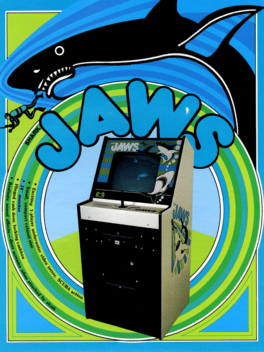
Shark Jaws is a 1 player arcade game by Atari Inc. originally released in 1975. Atari head Nolan Bushnell originally tried to license the Jaws name for the game, but was unable to secure a license from Universal Pictures. Deciding to go ahead with the game anyway, it was retitled Shark JAWS, with the word Shark in tiny print and JAWS in large all caps print to create greater prominence. Bushnell also created a second hidden subsidiary corporation, Horror Games - the previous being Kee Games, to help isolate Atari from possible lawsuit. The player controls a deep-sea diver trying to catch small fish while avoiding a great white shark that is trying to eat him. Points are scored by running over the fish to catch them.Western Gun
1975
Western Gun
1975
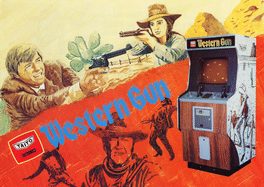
Western Gun, which served as an inspiration for Gun Fight in the USA (they're similar in gameplay and theme, but they're two different games), is a 1975 arcade shooter game designed by Tomohiro Nishikado, and released by Taito in Japan and Europe and by Midway Games in North America. It was the first video game to depict human-to-human combat, while the Midway version was also the first video game to use a microprocessor. Following its November 1975 release in North America, it went on to sell over 8,000 arcade cabinets in the United States. It was ported to the Bally Astrocade video game console as a built-in game in 1977 as well as several home computer platforms. The theme of the game involves two Old West cowboys armed with revolvers and squaring off in a duel. Whoever shoots the other cowboy first wins the duel. Unlike in a real-life duel, however, both cowboys get numerous opportunities to duel in order to score points (one point per successful draw).Speed Race DX
1975
Speed Race DX
1975
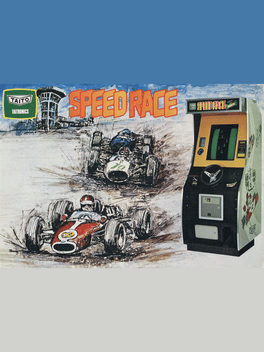
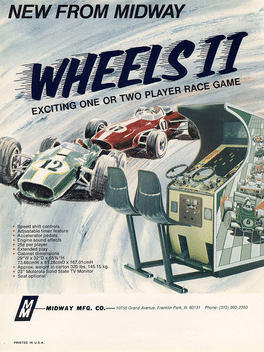
The original Speed Race and Wheels had an upright arcade cabinet, while Midway's Racer introduced a sit-down cabinet. Taito released an updated version of Speed Race called Speed Race DX in 1975. Speed Race DX is an updated version of Speed Race. The game plays mostly identical, with the player racing in a top-down view and gaining points for overtaking other cars. The cabinet is bigger and two new features have been added to the game with a gear shift lever and an in-game timer.Wheels II
1975
Anti-Aircraft
1975
Anti-Aircraft
1975
Anti-Aircraft is a two-player arcade game by Atari, Inc, originally released in 1975. The game is sometimes referred to as Anti-Aircraft II, denoting the two-player aspect of the game. Planes fly overhead, either singly or in pairs, in random directions in the aircraft flight area. The object is to shoot down more planes than the player's opponent during the time limit. Each player controls an anti-aircraft gun located in the lower left and right corners of the screen, respectively. A player's gun is controlled by three buttons located in each player's control station, which consists of a button for moving up, down, and firing. The up and down buttons move the gun to any one of three predefined positions.Drop Zone 4
1975
Super Flipper
1975
Super Flipper
1975
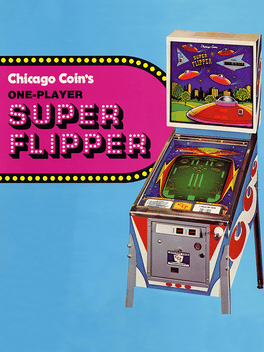
Super Flipper is a pinball game that is more of a mix between Pong and Breakout. Using flipper buttons, which move side to side and further depending on how hard you press, you keep the ball in play to score as many points as possible. Originally made in Italy where it was known as UFO before being distributed by Chicago Coin as Super Flipper in the USA.Street Burners
1975
Pace Car Pro
1975
Pace Car Pro
1975
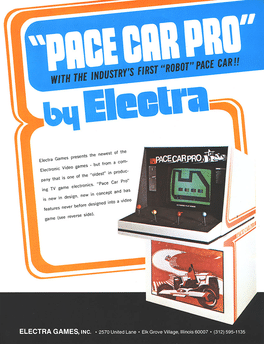
A four-player, high-speed car racing game where each person uses a joystick to control the speed, direction and brakes of his or her car.One of the first games to use a color monitor, an actual color TV set.Hi-way
1975
Indy 800
1975
Indy 800
1975
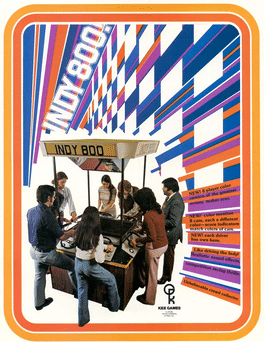
The game is housed in a large custom rectangular cabinet. Each side of the cabinet has two steering wheels and four pedals. The monitor is set in to the top face of the cabinet and looked down upon. The game uses a 25 inch full color RGB display and does not use color overlays, representing the first full color video game.UFO Chase
1975
Pursuit
1975
TV Pingame
1974
TV Pingame
1974
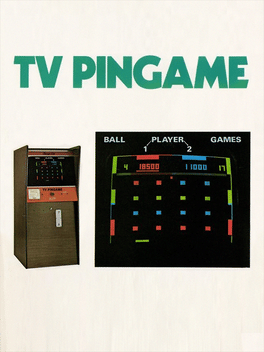
A pinball game where a ball and paddle are used to knock out bumpers, hit pockets and a moving target at the top of the screen to score points. Keep ball in play by bouncing it back up and knock out all the targets for bonus points. It has been produced under different names by Chicago Coin, Exidy and Midway Manufacturing Co.Attack UFO
1974
Attack UFO
1974
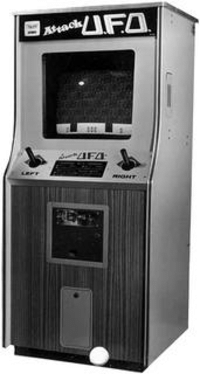
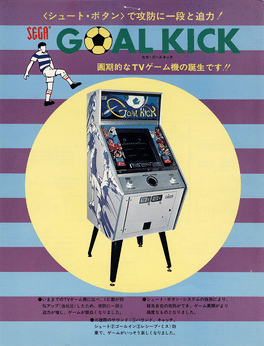
The player controls guided missiles shot from the bottom of the screen and tries to steer them into the attacking U.F.O.sGoal Kick
1974