New Arcade Games - Page 144

Eliminator IV
1976
Eliminator IV
1976
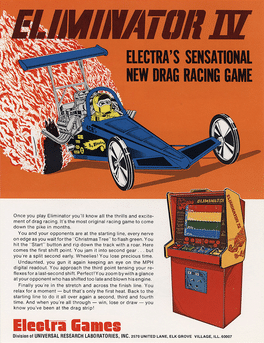
Eliminator IV is a drag racing game released by Electra games in April 1976 as an arcade cabinet. Up to 4 players can play, using realistic, H-pattern gear sticks.Quiz Show
1976
Death Race
1976
Death Race
1976
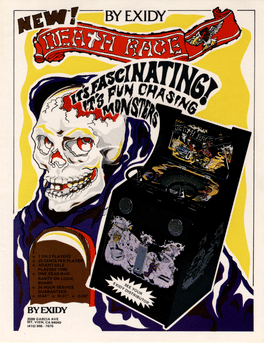
star 4.9Death Race is a vehicular combat game that puts your car in an open space with gremlins. Your goal is the crash into the gremlins so you can brutally and cruelly kill them. Upon dying, they scream. In the spot where the gremlin once was, a cross-shaped gravestone will be left. This clutters the playing field, making it harder to move around. There are dotted lines on the sides, representing two narrow "safe" zones on the left and right sides of the screen for the gremlins, as your car will crash on contact with the dotted lines.Nurburgring-1
1976
Nurburgring-1
1976
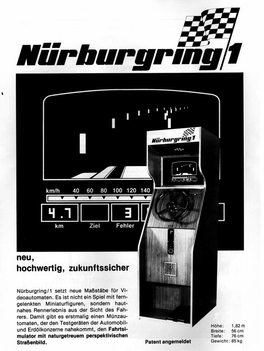
Considered by many to be the first fully electronic, first-person driving simulator, this was Dr. Reiner Forest's attempt at miniaturizing the racecar driving experience. It directly inspired Ted Michon's game Night Racer, which in turn led to him working with Midway to create 280 Zzzap around the same time. Meanwhile, Atari designer Dave Sheppard saw a screenshot of what was very likely Nürburgring 1 in a magazine; this led to the company's own iteration, the better-known Night Driver. The arcade cabinet has a black and white monitor, a steering wheel and two foot pedals for gas and brake. The screen is completely black with white rectangles representing roadside poles. A monitor overlay sticker displays the car hood and boxes at the bottom of the screen for the distance, speed and misses. The player gets 90 seconds to drive across the finish line; crashing the car results in a time penalty. The game plays the sound of the engine and screaming tires.Outlaw
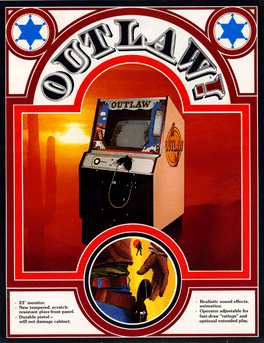
1976
Interceptor
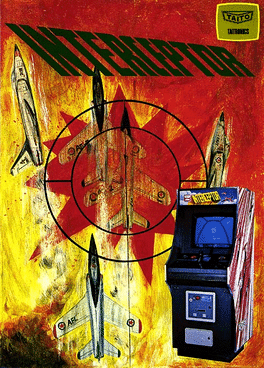
1976
Road Race
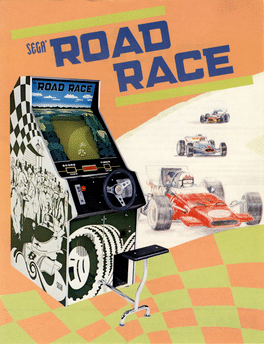
1976
Ace
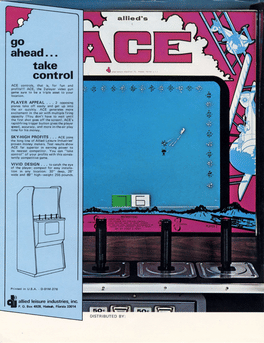
1976
Bombs Away
1976
Bombs Away
1976
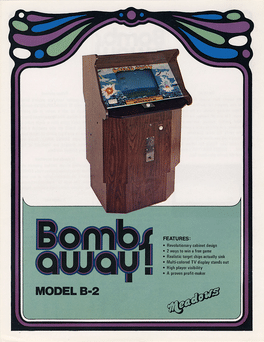
A sequel to Drop Zone 4, produced by Meadows Games in 1976, where a bomber plane attempts to sink an entire fleet of ships.Demolition Derby
1976
Demolition Derby
1976
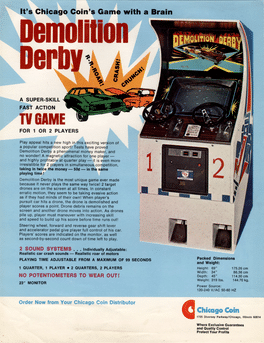
A black and white driving game where each player controls a pursuit car that tries to demolish drone cars to score points. Challenging and fast-moving super skill play, and never plays the same twice! Two target drones are always on the screen, darting around in competive evasive action as though they are controlled independantly. When a player has his or her car hit a drone, the drone is demolished and a point is scored. Drone wreckage remains on the screen and another comes into action. As drones pile up, each player must maneuver with increased speed and skill to increase his or her score before time is up. (Destruction Derby was the Exidy release from 1975, it was later licensed to and released by Chicago Coin as Demolition Derby in 1976)Goal IV
1975
Bullet Mark
1975
Bullet Mark
1975
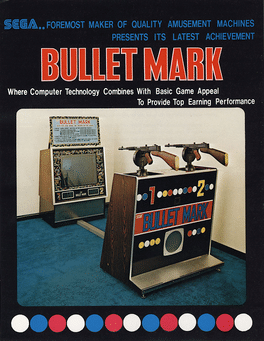
A light gun game by Sega released in 1975. The unweildy cabinet proved unpopular with distributors, leading to the development of a scaled-down version called Tracer in 1976. This game was the first Sega game to be produced in America.EVR Race
1975
Avenger
1975
Avenger
1975
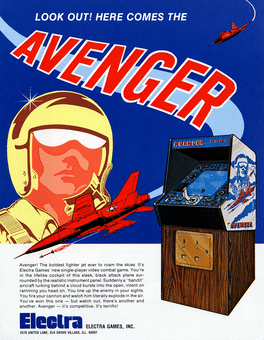
The game has a top-down view of a aircraft scene. Your fighter is at the bottom and you control its speed and horizontal position with the joystick. The scene scrolls from top to bottom and enemy aircraft appear at top of screen, flying down towards you. The Afterburner button lets you quickly speed up.Crossfire
1975
Crossfire
1975
The game required two players, each with a gun, at opposite sides of the playfield. Each player had a vertical position knob (a potentiometer like Pong) and a fire button. Each gun could have one shot in the air at a time. There was a big ball, which started at the center, and there were small bumpers in the playfield that made the ball bounce. You tried to “push” the ball into your opponent’s goal line by shooting it. Each hit added a little energy and it took multiple hits to get the speed of the ball up, but then you had to watch out for rebounds off the bumpers. An interesting aspect of the game was the one-shot-at-a-time rule. If the ball was on your side of the field, then you could shoot more often than your opponent (unless, of course, you missed and had to wait for the shell to cross the entire screen). This made it possible to achieve remarkable come-backs from near-certain defeat.Destruction Derby
1975
Destruction Derby
1975
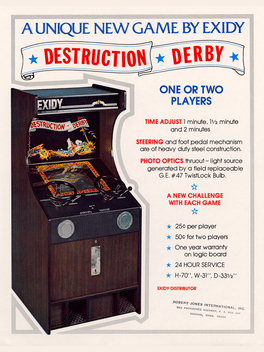
Exidy's first driving game, which was later licensed to Chicago Coin and released as "Demolition Derby". As part of the deal, Exidy stopped production of the game to avoid competing with their new licensee.BiPlane
1975
Shark
1975
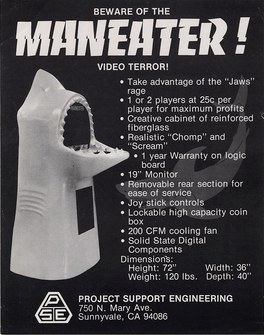
Maneater
1975
Fire Power
1975
Fire Power
1975
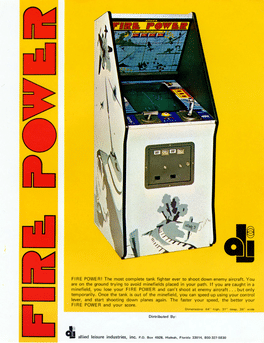
Fire Power was produced by Allied Leisure Industries in 1975. A land versus air combat game where the player controls a tank that must shoot down enemy aircraft while avoding minefields on the ground.