Most Popular Atari 2600 Games - Page 33

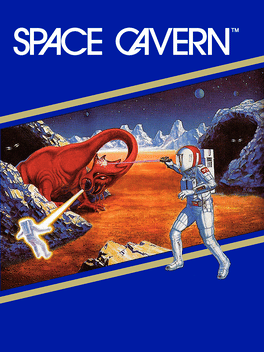
Space Cavern
1981
Space Cavern
1981
As a commander of a spaceship you explore an unknown planet and are soon attacked by its inhabitants - the Electrosauri. You are shot at from above as well as from the sides and it becomes increasingly difficult to fend off the attackers the further the game progresses. The game allows the player to play several variations (e.g. difficulty level, number of enemies on screen, attack patterns etc.).Lost Luggage
1982
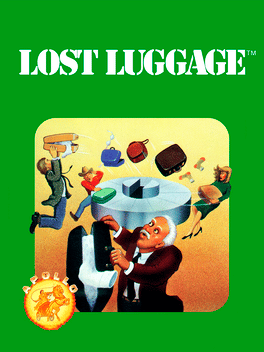
Lost Luggage
1982
This Kaboom!-clone takes place in an airport. Instead of catching bombs before they hit the ground you have to catch suitacses which are thrown from a luggage carrousel gone haywire. The games becomes progressively harder as more and more suitcases are hurled towards the ground. In addition to that you can chose between two difficulty levels which let you control one or two baggage handlers. You should also watch out for suitcases containing bombs - failing to catch those results in instant death.Riddle of the Sphinx
1982
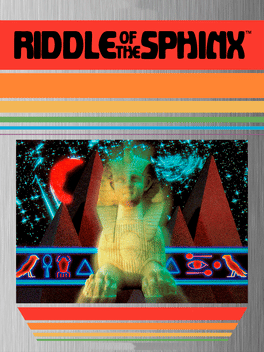
Riddle of the Sphinx
1982
The land of Eypt is cursed and it is up to the pharaoh's son to lift the curse. In order to do so he has to wander through the hot desert and collect treasure from ancient pyramids and temples. He will encounter poisonous scorpions, violent thieves who will steal the prince's collected items and the evil and invincible god Anubis himself. To make matters worse, the prince has to fight thirst in finding some of the rare oases scattered throughout the desert. But the prince will also encounter the good goddess Thetis and friendly traders who will give up willingly some of their items in order the help the prince on his quest. Only if he solves the riddle and brings the right items to the Great Sphinx he will eventually lift the curse.Fire Fighter
1982
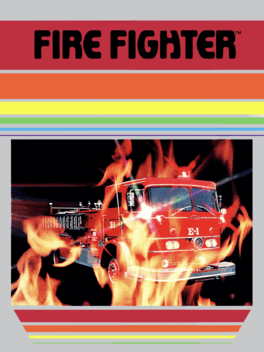
Fire Fighter
1982
The objective of the game is to save a person trapped in a burning building. In order to do so you have to extinguish the fire with your fire hose. To complicate matters further the fire will spread to the next floors and you only have a limited water supply. After extinguishing the fire you have to allign the ladder of your fire truck to the floor where the person is on so that he can climb to safety. In subsequnt levels the building has fewer floors resulting in a higher difficulty level.Planet Patrol
1982
Planet Patrol
1982
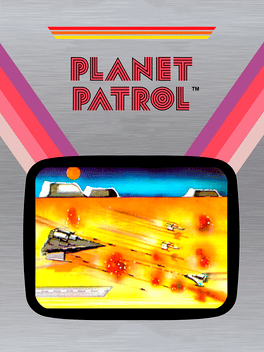
In Planet Patrol it is your misssion to destroy fuel depots of the enemy. You are flying from right to left while dodging oncoming missiles and shooting down enemy ships. In order to replenish your fuel you firstly have to fly into a black ship which will cause a landing strip to appear. After having succesfully landed a truck will refill your ship with fuel. After nightfall enemy ship are not discernable from the background anymore. In order to see them the player has to fire his weapons which makes the enemy ships briefly visible again in the ensuing muzzle flash.Stellar Track
1981
Stellar Track
1981
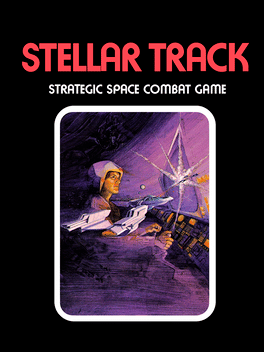
Stellar Track is a text- and turn-based strategy game where the player controls a Terran Super Warship that must clear out alien ships from all quadrants of a galaxy. It was a conversion of a college mainframe Star Trek game released by Sears in 1981. It is a suitably primitive game where you have to run scans to locate enemies and starbases on a 6 x 6 galactic map. You run scans to find the enemies then must warp to their quadrant to confront them with either phasers or photon torpedoes. You use the joystick to determine the numerals of where you intend you to travel to.Sprint Master
1989
Sprint Master
1989
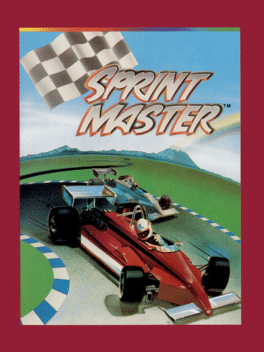
Sprint Master is an action racing game for the Atari 2600. The game is played from an overhead view of the racetrack, and the first of two players to complete the required number of laps wins. Occasionally, a bonus will appear on the roadway; players can collect it to increase their car's traction or gain a temporary speed boost. Other obstacles, such as oil slicks, may also appear on the roadway, causing players to lose control and speed. There are a total of 9 tracks with varying levels of difficulty to race on, and players can choose blacktop, dirt, or ice as terrain.Slot Machine
1979
RealSports Volleyball
1982
RealSports Volleyball is an enhanced version of programmer Bob Polaro's never released game Volleyball. He asked to make several improvements on it, including better animations and more colourful backgrounds. It is part of the RealSports series of games.RealSports Tennis
1983
RealSports Tennis
1983
RealSports Tennis is a tennis simulation video game developed by Atari, Inc. for the Atari 2600, and published in 1983.RealSports Football
1982
RealSports Football
1982
RealSports Football is a 1982 football video game made by Atari for the Atari 2600, Atari 5200 and Atari 8-bit computer platforms. RealSports Football presents a greatly simplified version of football for play. Players in the game cannot go out of bounds or fumble the football, and there are no penalties in the game. Also, touchdowns automatically score 7 points; there is no kicking for extra points.RealSports Boxing
1987
RealSports Boxing
1987
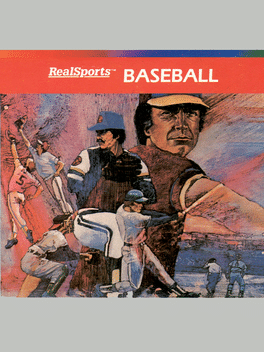
RealSports Boxing is a boxing based video game developed by Atari and released in 1987 for the Atari 2600. It is part of the RealSports series of games from Atari. The game has a side view of the ring, allowing the player to move up and down, as well as from left to right. There are four selectable characters in the game, Lefty O'Leary, Jabbin' Jack, Macho Man, or Iron Fists. The aim of the game is to knock out the opposition by filling up a bar at the bottom of the screen which allows the player to deliver the knock out blow. The game can be played with two players simultaneously.RealSports Baseball
1982
RealSports Baseball
1982
Join the Atari Aces in the World Series of video baseball--RealSports BASEBALL! It's a hot day in the ballpark--you can see the hot dog and soda pop vendors making their way up and down the bleachers. The crowd roars after each pitch, and filling the stadium is the sound of "STEERIKE! YOU'RE OUT!" Down on the field it's a different story--just you and the pitcher facing each other in an enormous diamond of brown and green. The roar of the spectators fades into the distance as the pitcher winds up. His arm arches back, his leg goes up, and...THUNK! The ball flashes by and hits the catcher's glove at 90 miles an hour. "STEERIKE!" Another windup, another 90 mile an hour fastball, and "STEERIKE TWO!" Gripping the bat tightly, you stare down at the pitcher, see him wind up, and watch as the ball seems to float in slow motion down the field toward you. Everything falls into place as you swing with perfect timing, feel the contact, and see the ball sail over the right fielders outstretched glove and over the wall. HOME RZippy the Porcupine
2014
Zippy the Porcupine
2014
Homebrew game created by "Sprybug" from the Atari Age forums. Basically a Sonic the Hedgehog clone for the 2600.Fast Food
1982
Fast Food
1982
The objective of the game is to eat as much fast food as you can by devouring the junk food that is approaching your huge mouth from the left of the screen. While doing that you should be careful to avoid the purple pickles - after having eaten six of those it is game over. Fast Food was written by Don Ruffcorn.Double Dunk
1989
Double Dunk
1989
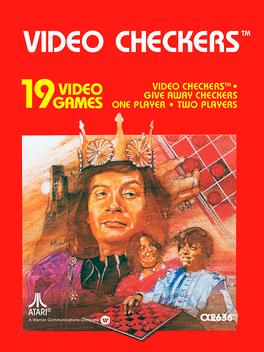
Double Dunk is a simulation of two-on-two, half-court basketball. Teams have two on-screen characters, a shorter "outside" man and a taller "inside" man. In a single-player game, the player controls the on-screen character closest to the ball, either the one holding the ball (on offense) or the one guarding the opponent with the ball (on defense). In two-player games, each player may control one of the two teams as in a one-player game, or both players may play on the same team against a computer-controlled opponent. At the start of each possession, both offense and defense select from a number of plays (such as the "pick and roll" on offense), then attempt to score or regain possession of the ball by intercepting or stealing it from the offense. The game offers a number of player-selectable options. Games can be set to last a certain amount of time or until one team scores a certain number of points. Three-point shots can be turned on or off, as can a ten-second shot clock. Players may also choose to include foulVideo Checkers
1980
Math Gran Prix
1982
Math Gran Prix
1982
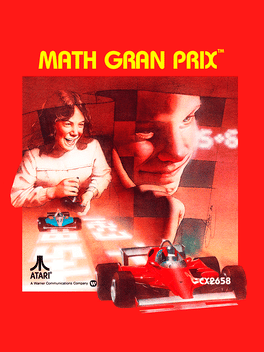
The principle of the game is to fuel your car with correctly answered math questions. It can move 2 to 3 spaces depending on how hard the math problem is. The track contains many triggers that can give extra spaces, extra turns, and even keep your car on the track. There are areas in the track where a car coming from behind can knock you off, to get back answer a math problem correctly. In the end, the one with the most math skills and greatest planning effort will win the checkered flag.Backgammon
1979
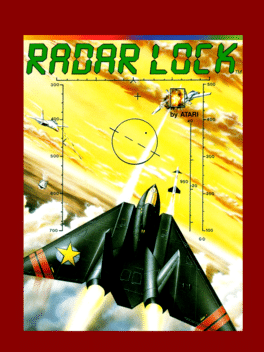
Radar Lock
1989
Radar Lock
1989
You're locked in fight-to-the-death air combat with the enemy! You may be outnumbered -- somehow you've been separated from your buddies -- but this is far from your first mission. You've been flying your trusty little delta-wing fighter for more months than you care to remember.