This multiplayer-only Bomberman release is exceedingly rare and seems to have been produced for demo kiosks, tournaments, or both.
Users Battle is a Bomberman game for the PC Engine, released only in Japan. It bears a 1990 copyright, just like the original release of Bomberman for the platform. Additionally, it plays the same title screen music upon boot, but it has a different title screen, only allowing for multiplayer play for two to five players. It lacks the skull mode option of the full Bomberman release, but otherwise shows similar menus and styles to Bomberman's multiplayer mode.
It is believed that Users Battle was created in extremely limited quantities for use at tournaments, demo kiosks, or both. Some online sources estimate the number of cards produced at around 1,000.
Fray in Magical Adventure, also known as just Fray (フレイ) and Fray-Xak Epilogue (Gai-den), is a 1990 spin-off "gaiden" (sidestory) game in a role-playing video game series Xak developed and published by the Japanese software developer MicroCabin. Even though it is directly connected to the more serious Xak storyline, Fray has a less serious tone and light-hearted comedic approach to telling the story. It was originally released for the MSX2 and was later ported to several different systems, among them MSX turbo R, PC-9801, PC Engine (as Fray CD), and Game Gear.
Fray is a simple action RPG. The game proceeds by the player's character Fray fighting through a preset overhead view map shooting opposing monsters, jumping over obstacles, and locating powerups and Gold, the game's currency, along the way. At the end of each stage the player will fight a boss and enter a town or safe haven where the player can purchase new equipment, hit points and the option to save their progress. Fray advances in power through the
The player attempts to manage an oil drilling operation and collect oil, while evading subterranean creatures. The player can advance through eight different levels, using four directional control buttons to move the drill head, and pressing a button to quickly retract it.
Italy 1990 (also known as World Class Soccer in the United States and Italia 1990 in most of Europe) is a soccer video game published by U.S. Gold and programmed by Tiertex Design Studios in 1990. It features the 1990 FIFA World Cup held in Italy but is not part of the official FIFA World Cup series. For the American market it was branded as World Class Soccer. In Europe (except the U.K.) it was released as Italia 1990 by U.S. Gold in association with Erbe Software. It was released for Amiga, Amstrad CPC, Atari ST, Commodore 64, ZX Spectrum and DOS.
You're second in the grueling competition of an all-day MotoRodeo. Your customized truck, a cherry little number, speeds through the dangerous obstacle course. You quickly break through a brick wall, rumble through a muddy ditch, and jump high into the air. You grin widely as you land on a Plymouth, crushing it beneath the weight of your monster truck.
Up till now, you and your opponent, Trucker Tom, have been neck and neck throughout the competition, but you've just pulled ahead. Your truck paid its dues during the early part of the competition, but you're confident that you've got the skills needed to outmaneuver Tom as you race for the finish line.
Your adrenalin pounds. You psych yourself up for the few remaining obstacles. You're only slightly ahead of Tom, but there are still a few more walls and cars to crush. Good thing you learned quickly to jump the mud which is slowing Tom down.
You rev your engine, add a burst of acceleration, and jump the last mud hole as you race for the finish line. Trucker
Rollergames is a coin-operated arcade game by Konami, made in 1990, and based on the television show of the same name.
Score values are cut in half from the real show (and rounded up if needed), and feature only four 99-second cycles instead of 45-second cycles within four 6-minute periods.
The players control the two jetters. After referee Don Lastra blows his whistle to begin the cycle, the first lap leads the jetters to the Wall of Death (the heavily banked curve of the jetwave). They get one point for getting three steps in the between the two red lines and three points for getting above the top line. On the jet jump, they get three points for landing beyond the 12-foot marker and one point for landing in front of the line. The rest of the cycle awards one point passing or fighting off opposing blockers (who come back to haunt the jetters afterwards) and three points for lapping or fighting off the opposing jetter. The team with the most points wins.
While it doesn't affect the score of the game (only awardi
Players control Duke Oda, a member of the Cyber Police force in the city of Liberty who tries to clear the streets of crime, terminate the most wanted criminals and put them behind bars. There are 15 stages to complete, which takes the player through Liberty streets, car yards, stadiums, restaurants, the CBD, and boat docks. There are bosses on some stages. During each stage, the player picks up ammunition with varying amounts. For example, on some levels, ammo may be worth 10 bullets, while in others, there may be 60 bullets.
Bosses attack in several ways. Note that the bosses are not just people. The player also battles an ape, a tiger, a monster truck in "Eagles Stadium", and cyborgs. Once these first three bosses are defeated, the player's rank rises to captain, followed by assistant chief, and finally to chief.
Once the chief rank has been achieved, the player is given a cyber suit, which is described by the game as a "long-range supersonic powered suit" which contains two Turbo-Booster Thrusters, and provid
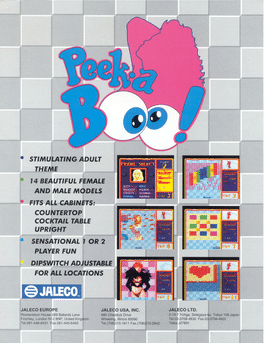
A collection of colored blocks appears on the screen along with two glowing diamonds. Single colored blocks fall from the top of the playfield and your task is to complete a horizontal row on the same level that each flashing diamond appears.
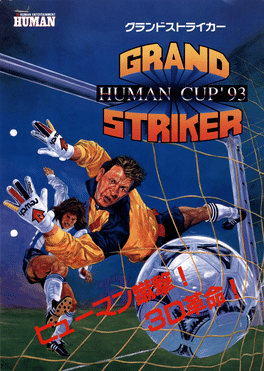
An arcade football/soccer game. The game scrolls horizontally at a slight angle, and recreates the coin-op's close-up zoom effect after a player scores. Only a small area of the pitch is on screen at a time, but there is a scanner to show the whole pitch.
Although the game has a referee, he often loses attention, and these moments give you a chance to foul, punch or side-swipe opposition players. One and two player options are included.
Super Skweek is a game inspired by the wide success of Chip's Challenge, and shares some elements of that puzzler while combining other elements from games such as Pengo.
In Super Skweek, you play the title character who must walk around and either paint all the tiles of the game board pink, complete a specific mission, or both. Some tiles react in various ways when you walk on them, like exploding.
Unlike Chip's Challenge, the game plays in realtime and you can pick up and use weapons to keep away certain monsters as you paint the tiles. There is also a shop you can enter to purchase items. Finally, levels have a time limit for completion.
Darius Alpha is a promotional version of Darius Plus released in 1990 for the PC Engine. It was a mail-order exclusive, obtainable by sending in a pair of coupons found in the manuals of Super Darius and Darius Plus. There were only 800 copies of the card produced, making it one of the rarest, and the absolute most expensive, PC Engine HuCard ever made. This version is only a Boss Rush, where the player faces against all Plus bosses one after another.
Like Plus, Alpha features SuperGrafx support, which greatly reduces sprite flickering.
Pressing Select on the title screen starts the game with a 4-minute time limit.
Pinball Magic is an early pinball game by French company Loriciel.
In a nice twist to regular pinball tables, here you have to clear tables by activating all letters, which opens the exit to the next table.
Lost Patrol is a survival action role-playing game with strategy elements. "We’re fit, we’re alive, but we’re not back home." In this classic multi-genre DOS game, take command of the seven survivors of a U.S. helicopter crash in Vietnam, desperately trekking across 57 miles of harsh terrain infested with booby traps and enemy soldiers.
Supremacy: Your Will Be Done, released as Overlord in the US, is a strategy video game designed by David Perry & Nick Bruty and produced by Probe Software.
The goal of Supremacy is to create and protect a network of planetary colonies and defeat a computer adversary who is trying to do the same. There are four skill levels, each represented by an enemy race, and each featuring a progressively stronger opponent. The more advanced a system is, the more freedom a player has when purchasing spacecraft. Higher skill levels also result in different numbers of planets in each system.
The game was initially released for the Amiga and Atari ST computers in the beginning of 1990.