Most Popular Legacy Computer Games

Tetris
1985
Tetris
1985
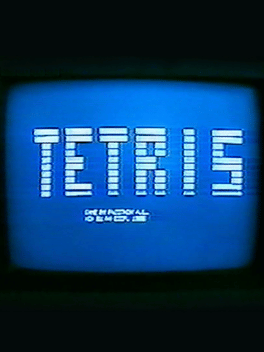
star 7.5The original version of Tetris was created by Alexey Pajitnov for the Elektronika-60 computer. It was never released commercially. It was also playable on the successor DVK-1 and DVK-2 computers, although it is unknown whether that is a different version, or simply the same code running on a different computer. Minor visual differences are present, but the gameplay is the exact same.DikuMUD
1991
Mac Hack VI
1966
Mac Hack VI
1966
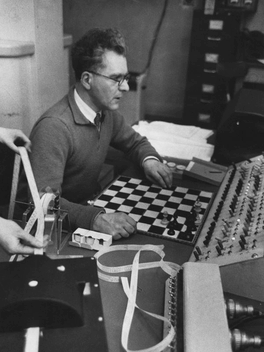
Mac Hack VI, a.k.a. The Greenblatt Chess Program is a chess program that ran on the PDP-6. It was written in MIDAS and was the first computer program to play in a human tournament and be granted a chess rating in 1967. The game was inspired by the Kotok-McCarthy-Program, but improved upon it in design and search width.War
WAR was a two-player strategy game for the CDC-6600, created in the mid 1970's at the University of Texas at Austin.Mate-in-Two
1951
Mate-in-Two
1951
Robot Chess is an early chess game in which the user can play against an AI. The AI is only powerful enough to compute "mate-in-two" problems and thus the game didn't represent a full game of chess. Players would enter moves of the Ferranti Mark 1 and the computer would print out the response move. The simulation ignores some chess rules such as en passant, promotion and castling.Bouncing Ball
1953
Bouncing Ball
1953
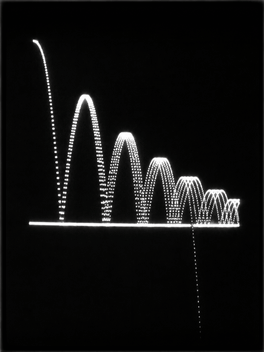
The first known game incorporating graphics that updated in real time, rather than only when the player made a move, was a simulation of a bouncing ball created by Massachusetts Institute of Technology (MIT) student Oliver Aberth for the Whirlwind I computer. He began creating the simulation in February 1951, before the computer was completed in April. It allowed users to adjust the frequency of the bounces with a knob, and sometime between late 1951 and 1953 he made it into a game by adding a hole in the floor for players to aim for.