New Sport Games - Page 260

Soccer
1973
Soccer
1973
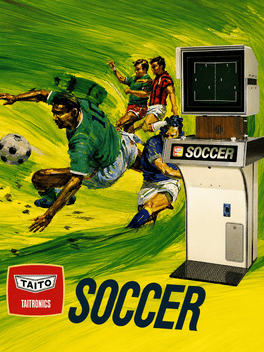
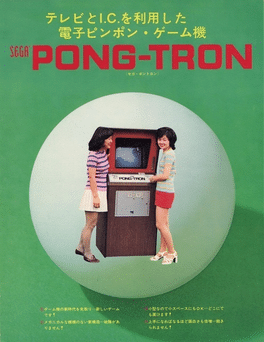
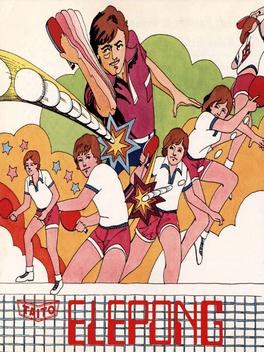
Soccer is Taito's third ever video game release and the first developed internally. The game was designed by the highly influential Tomohiro Nishikado, who would later go on to create Space Invaders. Soccer is a ball-and-paddle game like Pong, but with a green background to simulate a playfield, allowing each player to control both a forward and a goalkeeper. The players can adjust the size of the players, who are represented as paddles on screen. It also has a goal on each side. Soccer is likely to be Japan's first original domestically produced video game, in comparison to Japanese Pong clones released earlier, including Sega's Pong Tron and Taito's Elepong. Since it was exported to Europe in 1973 it may also be the first Japanese video game to be released on the European continent.Pro Hockey
1973
Pong-Tron
1973
Tennis Tourney
1973
Tennis Tourney
1973
Allied Leisure's second game was a four-player version of Paddle Battle. It was the first four-player Pong-style game, predating Atari's own Quadrapong by two months.Elepong
1973
Paddle Battle
1973
Paddle Battle
1973
The first video game produced by Allied Leisure. It is a clone of Atari's pong, and was created by electronics firm Universal Research Laboratories more-or-less copying the board from a Pong machine Allied had purchased from a distrubutor.Volleyball
1972
Volleyball
1972
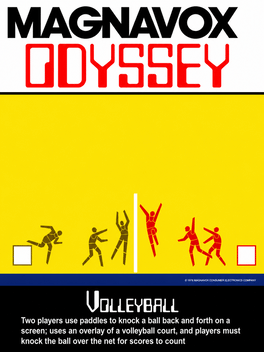
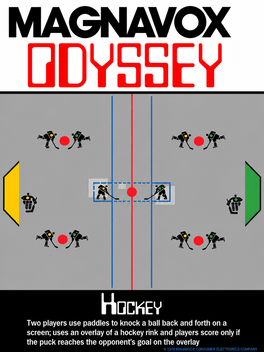
Magnavox Odyssey launch title, sold separately. Two players use paddles to knock a ball back and forth on a screen; uses an overlay of a volleyball court, and players must knock the ball over the net for scores to count. Uses game card number 7.Soccer
1972
Soccer
1972
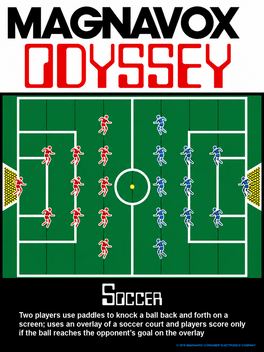
Soccer replaced the game Football in European export versions of the Magnavox Odyssey. It uses a custom screen overlay and two game cards, #3 and #5. The gameplay is a variant of Table Tennis in which the horizontal position of players is fixed (although not enforced by the Odyssey console itself). If a player manages to maneuver the ball around the opponent, the next volley will take place one step closer to the opponent's goal. Once a player has reached a position in the opponent's half of the playing field, a goal can be scored. The game also includes rules for penalty kicks, which require changing the game card.Handball
1972
Hockey
1972
Baseball
1972
Play Ball
1972
Play Ball
1972
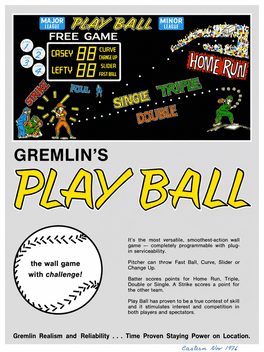
Play Ball was produced by Gremlin in 1972. From flyer: "It's the most versatile, smoothest-action wall game - completely programmable with plug-in serviceability. Pitcher can throw Fast Ball, Curve, Slider or Change Up. Better scores points for Home Run, Triple, Double or Single. A Strike scores a point for the other team. Play Ball has proven to be a true contest of skill and it simulates interest and competition in both players and spectators. "PDP 10 Timesharing Basketball
1967
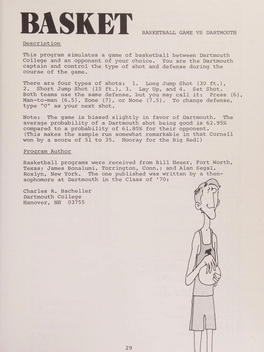
The first Basketball video game. You play against the computer in a text-based game of Basketball, with the ability to select both defensive setup and offensive plays each turn.Pool
1954
Pool
1954
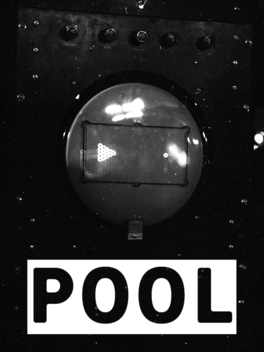
A game of pool (billiards) developed by William George Brown and Ted Lewis in 1954 on the MIDSAC computer, intended primarily to showcase the computing power of the MIDSAC. "The game displayed a 2-inch rendition of the pool cue for the players to line up their shots and ran a simulation of the colliding and ricocheting balls in real-time, implementing a full game of a cue ball and 15 frame balls for two players. Graphics were drawn in real-time on a monochrome 13" point plotting X-Y display, the screen being updated by the program 40 times a second (that is, in a normal in-game situations with 2 to 4 balls moving at once). However, for time constraints, the table and its pockets weren’t drawn by the computer graphics, but were rather drawn manually onto the display using a grease pencil." - Norbert Landsteiner for masswerk.at