Most Popular Fairchild Channel F Games - Page 3

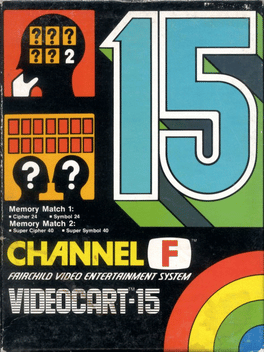
Videocart-15: Memory Match
1978
Memory Match is a game where the player is given the task of flipping over cards two at a time in the hopes of having them match. If the cards match, they disappear from the playfield. If they don't match, the cards are flipped back over face down and the player tries again. The better the player is at memorizing where the overturned cards were, the easier it will be for him to find a match. The game contains 4 variations of its basic premise. The Memory Match 1 variations offer a smaller grid thus making it easier. Memory Match 1: Cipher-24 (6x4 grid with numbers) Symbol-24 (6x4 grid with symbols) Memory Match 2: Super Cipher-40 (10x4 grid with numbers) Super symbol-40 (10x4 grid with symbols) The game offers both 1 and 2-player modes. When playing alone, the player tries to clear the board in the fewest amount of guesses. In the multiplayer, both players try to get more matches than their opponent.Videocart-26: Alien Invasion
1981
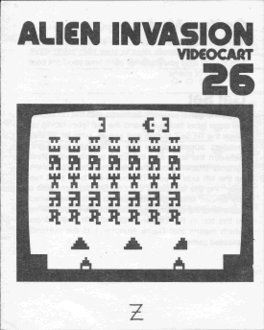
In this Space Invaders variant, the player controls a gun turret at the bottom of the screen and fires missiles at incoming alien ships. The turret can move both left and right and hide behind three protective barriers. The alien invaders move left and right, fire missiles at the player, and slowly approach the planet surface - if they land, the player loses the game. Every once in a while, an alien mothership will fly across the top of the screen and shooting it will give the player extra points. The goal of the game is to destroy all alien ships in each attacking wave and score as many points as possible. The game ends when players lose their three lives.Videocart-25: Casino Poker
1981
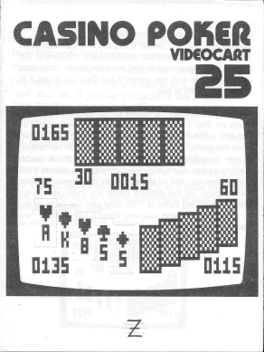
A simulation of the five-card draw poker variant. There is a computerized dealer and two more players (human or computer-controlled), and each one is dealt five cards. The players then take turns either calling or raising a bet (of up to $25) or, if they don't like their cards, they can fold. Once that round of betting is done, players can then choose to discard up to three of their cards in exchange for new ones, in an attempt to make a better hand. Another round of betting then takes place and, after that, all the players that didn't fold must show their cards. Whoever has the highest hand wins all the money in the pot.Videocart 20 - Schach
1979
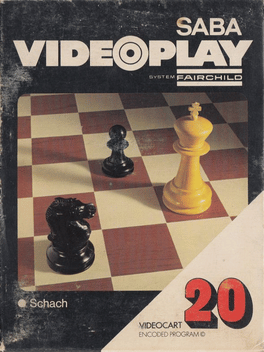
Schach (German for "chess") was released for the Saba Videoplay, a Channel F-compatible system that Fairchild licensed for the European market. In this early chess simulation you can only play against the machine, as there is no multiplayer support. The player can chose either the white (actually green on screen) or black (actually red) pieces, and can select from 4 different AI difficulties. The easiest AI plays its turns in a matter of seconds but, as the difficulty increases, each turn can take several minutes. In the highest difficulty, the AI can take up to 50(!) minutes to decide its move. To allow the player to watch something else on the TV while the system is busy, the game cart has a very special feature: an integrated red led lights up while the machine is "thinking". During the game, the player can ask the computer to help him with his next move. In those situations, the system analyses the board and plays impartially.